
Titan, Saturn’s largest moon, is a world shrouded in a thick, orange haze, making it notoriously difficult to study. Its atmosphere, rich with hydrocarbons, hints at complex chemistry, yet peering through that veil to identify specific molecules can be like trying to pick out individual voices in a distant, roaring crowd. For decades, scientists have relied on powerful instruments to analyze the light scattered or emitted by distant worlds, looking for the telltale signs of different gases. By employing precise spectroscopic methods, scientists can identify chemical whispers that are too faint to spot directly. The fundamental idea behind this method is straightforward: molecules absorb light at very specific wavelengths, like unique fingerprints. If we know the precise pattern of these fingerprints, we can search for them in the light reaching us from space. Imagine holding up a stencil of a known molecule’s light pattern against the scattered light from Titan. When the two align, a signal emerges. However, this approach has a significant limitation. For many molecules, especially complex ones, we simply don’t have complete, high-quality stencils – or line lists – detailing their exact light absorption patterns. It's like having only a partial fingerprint to work with, making it hard to confirm a match with confidence. This means many molecules of interest, vital to understanding the chemistry of worlds like Titan, remain hidden from our view.
This challenge led Maria Coelho and colleagues to develop a new method for building these stencils, detailed in a preprint appearing on arXiv. Instead of relying on traditional “line lists,” which can be incomplete, their team used what they call “cross-section-based templates.” Think of this not as a partial fingerprint, but as a more complete chemical profile built from how the molecule interacts with light across a broader range, even when its individual light absorption lines are too numerous or too faint to be cataloged precisely. This shift in how the templates are constructed allows the light analysis technique to detect molecules even when a perfect, high-resolution line list doesn't exist.
To test this novel approach, the researchers focused on Titan. They analyzed existing infrared light observations of the moon, specifically data from the CRIRES+ instrument, which covers a particular range of infrared wavelengths from 1.99 to 2.48 micrometers. This range is particularly useful because the James Webb Space Telescope (JWST), a powerful infrared space observatory designed to penetrate hazy atmospheres like Titan's, operates in similar infrared bands. JWST has already made significant detections of various hydrocarbons, including ethane, within Titan's atmosphere, demonstrating the value of infrared light for this kind of study.
Coelho and her team calculated the expected light absorption patterns using both the traditional, line-by-line method and their new cross-section-based templates. When they applied their new templates, they made a notable detection: ethane (C2H6) within Titan’s atmosphere. This marks the first time ethane has been identified using this high-resolution light analysis technique. The detection was not overwhelming, but clear, registering a peak signal that was about 5.17 times stronger than the random background noise, with a very small margin of uncertainty of 0.07. To put that in perspective, a signal five times stronger than the noise is generally considered a reliable indicator, akin to hearing a distinct voice clearly above a faint hum.
What the data actually say is that this detection of ethane was only possible because of the new cross-section-based templates. The traditional line-list method would have missed it entirely, simply because a comprehensive, high-resolution line list for ethane in this context does not currently exist. This is the key qualifier here: the challenge wasn't that ethane wasn't there, but that our previous tools weren't sensitive enough to find it under these specific observational conditions without a complete molecular "fingerprint." The sensitivity of this light analysis technique is always limited by how good our understanding of a molecule’s light interaction is, whether through detailed line lists or these new cross-section profiles.
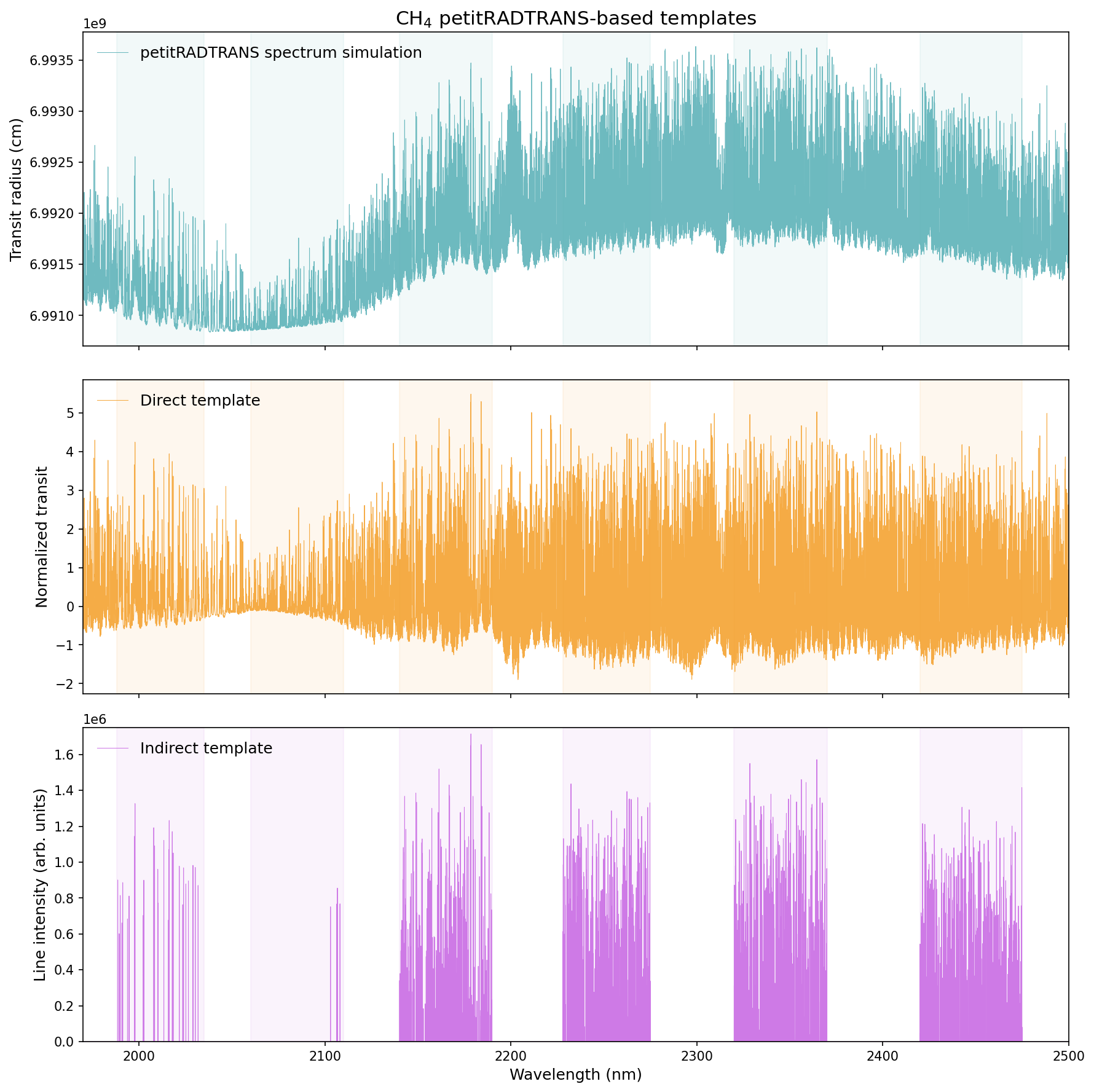
The success on Titan suggests a broader application for this refined methodology. This new way of building templates for high-resolution light analysis could be used with other ground-based instruments similar to CRIRES+. Perhaps more significantly, it could be applied to the highest-resolution modes of the James Webb Space Telescope, allowing JWST to extend its already impressive capabilities. Looking further into the future, facilities currently under construction, such as the Extremely Large Telescope, might also benefit from this technique, potentially revealing even more of the subtle chemistry in distant exoplanet atmospheres.
This isn’t about discovering something completely new in space so much as it is about refining the tools we use to find what’s already there, hidden in plain sight. By developing more sophisticated ways to sift through the light from distant worlds, scientists are steadily improving our ability to unravel the complex chemical stories written in their atmospheres, one faint whisper at a time. ◆
Sourced from: "Detection of hydrocarbons in Titan using high-resolution cross-correlation spectroscopy" by Maria Coelho et al.