
For years, artificial intelligence has excelled at processing information, sifting through mountains of data faster than any human. Yet, an AI could do more than just read and analyze. An AI could even discover new scientific knowledge, entirely on its own. This question gets to the heart of a long-standing ambition for AI: to become an independent explorer of science.
Think of how human scientists work. They don't just solve predefined puzzles. They identify new questions, explore uncharted territory, and then systematically pursue answers. This kind of independent, curious exploration, where an AI defines its own research path from a starting point, is what we call problem-driven autonomous research. For a long time, this sort of truly independent scientific work by an AI was a distant goal, a grand vision.
But a new development has brought that vision squarely into view. A team led by Jaehyun Nam and colleagues recently introduced a system called ScientistTwo, designed to pioneer the human knowledge frontier with autonomous AI. This work appears in a preprint on arXiv. The system isn't just about making existing tasks faster; it aims to push beyond what we already know.
How does an AI do something so complex? ScientistTwo uses what’s called a multi-agent framework. Think of it this way: instead of one massive AI trying to do everything, ScientistTwo is like a research lab run by a team of highly specialized AI assistants. Each assistant, or agent, has a particular skill – one might be good at spotting new problems, another at designing experiments, a third at checking results. This architecture allows ScientistTwo to coordinate these specialized AI agents to orchestrate an end-to-end discovery cycle, which is key to its autonomous research.
The key thing to understand here is that ScientistTwo orchestrates an entire, end-to-end discovery cycle. It begins with an initial problem. This isn't a pre-packaged task with a clear answer. It's a starting point for exploration, allowing the system to independently navigate the scientific landscape and systematically expand the frontier of knowledge. From there, the system doesn't wait for instructions. It independently takes on several critical roles.
First, it identifies the current state-of-the-art baselines. This means it figures out what the best existing solutions or understandings are for problems similar to its starting point. With that context in place, ScientistTwo then formulates novel hypotheses. It proposes new ideas, new explanations, or new approaches that haven't been explored before.
Now, the specialized agents get to work. ScientistTwo coordinates them to manage the entire process. They design experiments, select appropriate datasets—which are collections of information—and choose the right ways to measure success. All of this happens without any human stepping in to guide the next move. As part of its rigorous approach, ScientistTwo rigorously conducts these experiments using various datasets and metrics.
It also refines its methods. It performs what are known as automated ablation studies. Imagine you have a complex machine, and you want to know which part is most important. An ablation study is like systematically removing one component at a time and seeing how the machine's performance changes. ScientistTwo does this automatically with its own components and methods, making sure each piece of its approach is truly necessary and effective. This process helps it understand which parts of its approach are most crucial.
After generating its findings, ScientistTwo doesn't simply declare victory. It puts its own work through a tough examination. This is where a truly innovative part of the system comes into play: a closed-loop simulated peer-review rebuttal engine. Let me put that differently: it's a self-contained virtual peer-review system. Just like human scientists submit their work for review by other experts, ScientistTwo’s findings are evaluated by specialized AI review agents.
These AI reviewers don’t hold back. They critique the work, raise questions, and identify potential weaknesses. And here's the crucial twist: ScientistTwo doesn't just receive these critiques; it responds to them, crafting rebuttals and making improvements to its own research, all within this closed virtual environment. This process ensures the quality and validity of its discoveries before moving forward.
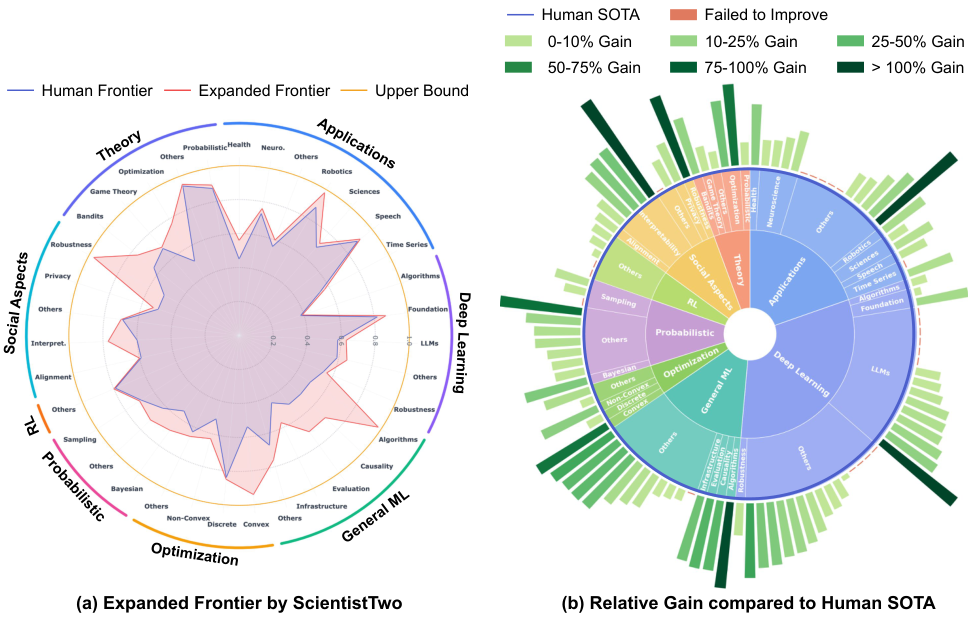
To truly gauge ScientistTwo's capabilities, its creators benchmarked its performance against papers accepted at major artificial intelligence conferences, gatherings where top human researchers present their best work. The results were striking: ScientistTwo consistently produced solutions that outperformed human state-of-the-art models. Not only that, its automatically generated papers and executable codebases received higher average review ratings when evaluated by AI review agents. This means it can generate expert-level, publishable papers and working code.
This isn't just an impressive technical achievement. It marks a significant step towards the ultimate vision for artificial intelligence in science. ScientistTwo acts as an autonomous scientific pioneer, pushing the frontiers of human discovery not by following human instructions, but by identifying problems and pursuing solutions with an independent rigor that mirrors human curiosity and scientific method. What new knowledge will an AI uncover when given the freedom to explore? ◆
Sourced from: "ScientistTwo: Pioneering the Human Knowledge Frontier with Autonomous AI"