

Mountain weather is notoriously difficult to predict. In a region like the Swiss Alps, sharp peaks and deep valleys create their own microclimates, where conditions can shift dramatically over short distances and within hours. For decades, highly complex physics-based models have been the standard tool for forecasting these fickle environments. But a new approach is emerging, using machine learning to parse vast amounts of historical weather data.
A team including Alberto Pennino and colleagues from institutions across Switzerland and France recently introduced Varda-single-1.0, a data-driven system designed specifically for this challenging Alpine domain. Their preprint, appearing on arXiv, describes a system capable of producing hourly regional forecasts down to a resolution of one kilometer—about the size of a small neighborhood. This level of detail is critical for understanding localized phenomena in mountainous terrain. The system also generates global forecasts, though at a coarser resolution of 31 kilometers.
Varda-single-1.0 relies on a specialized type of machine learning called Graph Transformer models. These models are particularly adept at recognizing intricate patterns and relationships within complex networks of data, which makes them well-suited for the interconnected variables of weather. The system uses two such models working in tandem: one generates a forecast every six hours, and the other fills in the hourly detail in between.
Developing Varda-single-1.0 involved a careful, multi-stage training process. First, the models were pre-trained on a broad global historical weather dataset. Then, they underwent intensive training using a massive, high-resolution dataset of regional weather conditions spanning two decades. The final step was fine-tuning the system with current operational weather analyses, to sharpen its performance over the specific complex topography of the Alps. This layered approach aimed to teach the system both the broad physics of weather and the fine-grained nuances of mountain microclimates.
To evaluate Varda-single-1.0, the researchers put it through a rigorous one-year verification period. They compared its forecasts against the actual operational analyses from MeteoSwiss, Switzerland’s national weather service, and against measurements from numerous surface weather stations. What they found was that Varda-single-1.0 performed competitively, often matching or even improving upon the skill of existing operational numerical weather prediction (NWP) models.
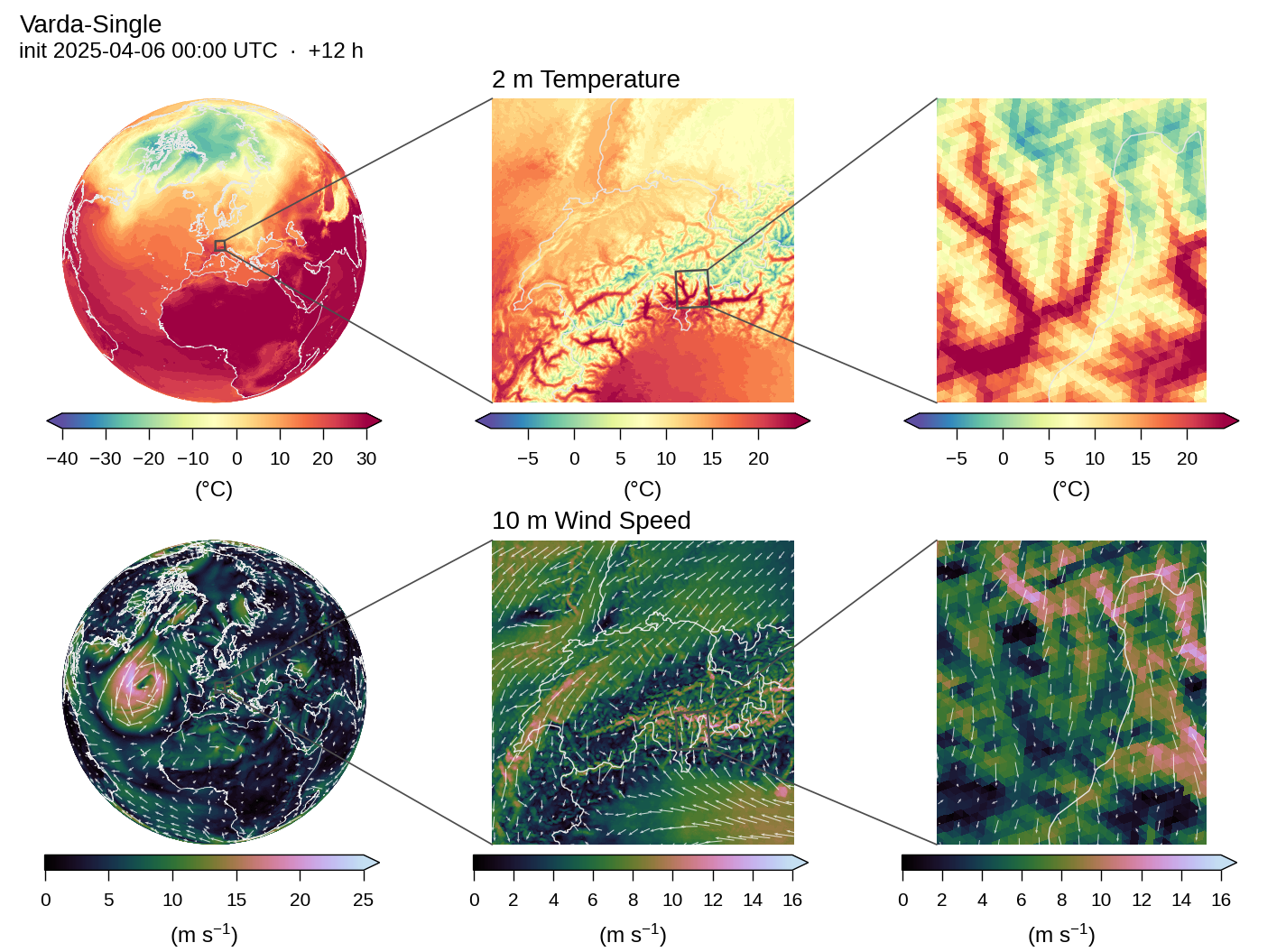
For instance, the system generally performed as well as the high-resolution 1-kilometer ICON-CH1-EPS control model—one of the best physics-based models available for the region—for forecasts up to 33 hours into the future. It also generally outperformed the 2-kilometer ICON-CH2-EPS control model for forecasts extending further, up to 120 hours. This suggests that data-driven models can indeed stand alongside, and in some aspects, even improve upon the established physics-based methods that have served us for so long.
However, careful thought reveals some important limitations. While Varda-single-1.0 shows strong overall performance, the researchers identified specific areas where its data-driven approach struggles, particularly with highly localized weather phenomena over complex terrain. For example, the model tends to underestimate certain local wind maxima. In mountain regions, these strong, isolated wind events are crucial for everything from aviation safety to understanding avalanche risk. Underestimating them could have serious implications. The system also produces what the researchers described as overly smooth predictions for convective precipitation, the kind of heavy, localized rainfall often associated with thunderstorms. This smoothing is a known characteristic of machine learning models trained using squared-error methods, where the model prioritizes minimizing average errors rather than capturing sharp, intense events. In other words, it tends to blend out the extremes. The team highlighted these weaknesses through specific case studies, revealing particular inaccuracies in how the model represents local wind patterns within the Swiss Alps. These findings have implications for the future of weather forecasting. Varda-single-1.0 is a significant step forward, showing that data-driven models can offer a powerful complement to traditional physics-based approaches, especially for high-resolution forecasting in complex areas. It’s also designed to be a "pretrained model," meaning it can serve as a valuable foundation for other researchers and specialized applications, potentially fostering a more collaborative approach to atmospheric science.
Yet, its identified weaknesses—the smoothed precipitation and underestimated local winds—underscore that even sophisticated machine learning models are not perfect. Future work will need to address these specific challenges, perhaps by exploring different training methods or hybrid approaches that blend data-driven insights with the deep physical understanding embedded in traditional models. The goal is not simply to predict, but to predict with the precision and nuance that truly reflects the reality of a mountain storm. ◆
Sourced from: "Varda-single-1.0: deterministic data-driven weather forecasting at 1 km resolution over Switzerland's complex topography" by Alberto Pennino et al.