
When light falls upon something, it does not simply vanish or reflect away in its original form. Often, it causes the object’s constituent particles to stir, to absorb that energy, and then to release it again as new light. Re-emission, a fundamental process known as resonance fluorescence, shapes how we see the world, from the glow of distant nebulae to the faint light scattering off dust motes in a sunbeam. For a long time, our understanding of this intricate dance between light and matter was largely based on the interaction of an atom with one or perhaps two particles of light, called photons. The scientific descriptions, honed over decades, largely concerned themselves with these relatively simple exchanges, explaining the observable quantum phenomena within this confined framework. What had remained largely unaddressed, however, was a more complex scenario: the possibility that an individual atom, in the very act of re-emitting light, could coordinate a more elaborate exchange, involving not just one or two photons, but several, all at once. The experimental investigation of such physical processes, where a solitary atom interacts with a greater number of photons during resonance fluorescence, had not yet been explored. This represented a substantial gap in our picture of how light interacts with the most basic units of matter.
Recently, a team of researchers, including Xiao-Long Zhou and colleagues in a preprint appearing on arXiv, turned their attention to this very question. They aimed to observe the delicate quantum fluctuations in the light emitted from a single atom held in a carefully controlled environment. Their method involved a precise measurement, one that could resolve individual scattering events even when three or four photons were involved. It was a careful attention paid to the whispers of light, a study of the subtle echoes when a single atom became excited and then relaxed.
What they found revealed a deeper complexity in this fundamental process. Their experiments showed that resonance fluorescence inherently involves what they termed multiphoton scattering. This means the atom was not just emitting single or paired photons, but sometimes groups of three or even four, all interacting and emerging together from a single encounter with the atom. The team resolved these third- and fourth-order photon scattering events, observing them directly, a feat that refines our existing framework for understanding how light re-emerges from an excited atom.
Among these newly observed interactions, a particular phenomenon emerged. The scattered photons in the three-photon component were found to be genuinely energy-time entangled. This means that these three photons, though distinct entities, were intrinsically linked by both their energy and the precise moment of their appearance, a connection so profound that the state of one cannot be fully described without knowledge of the others. It is a shared fate, a collective identity woven into the fabric of their existence. To confirm this deep connection, the researchers observed a violation of Svetlichny’s inequality, a demanding test that ensures the entanglement is not merely a statistical correlation but a true quantum linking across multiple particles.
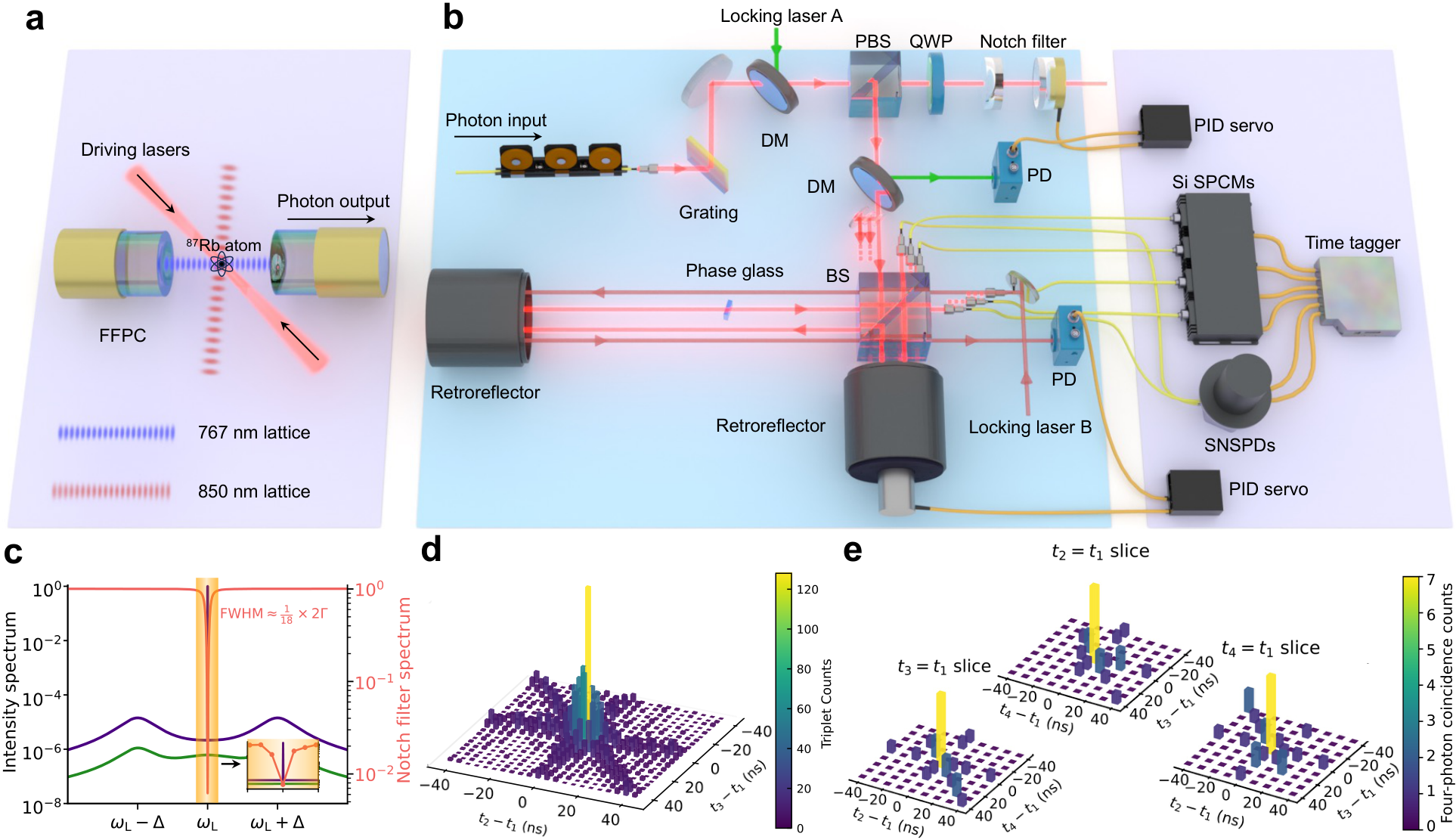
This discovery moves beyond a simple re-description of how light behaves. It establishes a straightforward method for generating these multiphoton entangled states. Such states are not mere curiosities; they are the bedrock for advanced technologies. They can be used for quantum information processing, which promises new ways to compute and transmit data, and for quantum metrology, a field focused on making measurements with unprecedented precision. As a tangible demonstration of this potential, the team implemented a quantum secret sharing protocol, using their newly discovered entangled photon source to distribute a secret among multiple parties, where no single party holds enough information to reconstruct it alone.
The world, in its deepest workings, reveals itself to be a place of persistent, intricate connection. What began as a simple observation of light re-emission from an atom now blossoms into an intricate understanding of multiphoton scattering and the genuine multiphoton entanglement it produces. We continue to learn that the most commonplace phenomena, when examined with sufficient care, hold entire hidden languages, waiting to be read. The universe, in its quiet, persistent hum, keeps revealing itself to be stranger, more deeply ordered, and more beautiful than we had remembered. ◆
Sourced from: "Observation of multiphoton entanglement in resonance fluoresce" by Xiao-Long Zhou et al.