
Imagine you’ve set up the most delicate domino rally in history, every piece meticulously placed, every tilt and angle accounted for. You step back, breathe a sigh of relief, and then — piff. — a single domino topples, then another, then the whole thing collapses into utter disarray. Only, there was no breath. No stray cat. No seismic tremor. It just decided to go chaotic all by itself. An absurd notion. In the world of physics, chaos usually needs a nudge. Think of a double pendulum, swinging wildly and unpredictably. You have to give it a push to get it going. Or a weather system, spiraling into a hurricane because of tiny changes amplified over time and space. Even in tiny magnetic systems, the kind of chaos scientists have studied for ages typically needed a constantly varying magnetic field or an electric current to stir things up. It was always a conventional, externally driven kind of chaos, something we instigated from the outside.
But now, a team led by Gyuyoung Park has found a magnet that generates its own chaotic behavior. No external forces required, no constant prodding needed. It’s like those dominoes deciding on their own to have an unpredictable, delightful, utterly unprompted meltdown. In a preprint appearing on arXiv, Park and colleagues describe a completely new kind of internal disorder, a phenomenon they call moiré magnetic chaos, and it emerges all by itself in a very specific material: twisted bilayer Chromium Triiodide, or CrI3 if you like shorthand. CrI3 itself is a fascinating material, a magnetic two-dimensional crystal. Picture a single, impossibly thin layer of magnets. Now picture two of them. The "bilayer part simply means two such layers stacked on top of each other. The "twisted part is where the magic, or rather the chaos, begins. Instead of stacking them perfectly aligned, you give one layer a tiny rotation relative to the other.
This slight twist creates a complex pattern called a "moiré pattern – the kind you see when two finely meshed screens are overlaid and slightly misaligned. This pattern, at an atomic level, radically changes how the magnetic forces between the two layers interact. Instead of neat, strong alignment, you get what the researchers describe as an "interlayer exchange frustration." Think of it as a constant, internal tug-of-war between the magnetic poles in the two layers. They want to align in one direction, then another, and because of the twist, they can’t quite decide. This indecision creates many dynamic elements within the system.
And these many dynamic elements, these tiny, medium-sized magnetic regions whose properties can change, start to interact in incredibly complicated ways. It's this internal, self-generated struggle that supplies all the necessary ingredients for chaos. No external pushing or pulling needed. The material, simply by being twisted, becomes an autonomous engine of magnetic unpredictability.
To see this in action, the researchers used detailed micromagnetic simulations. These are like incredibly precise computer models that track how the magnetism evolves over time in these materials. They started the simulations multiple times, each with only the tiniest, almost imperceptible differences in their initial states. What they found was a truly wild ride. Over vast ranges of these minute initial disturbances, the final magnetic patterns — the "moiré magnetic textures — were completely different. If you changed a single atom’s initial magnetic direction by an almost immeasurable amount, the whole system would relax into a radically different magnetic pattern. This extreme dependence on initial conditions is the hallmark of chaos.
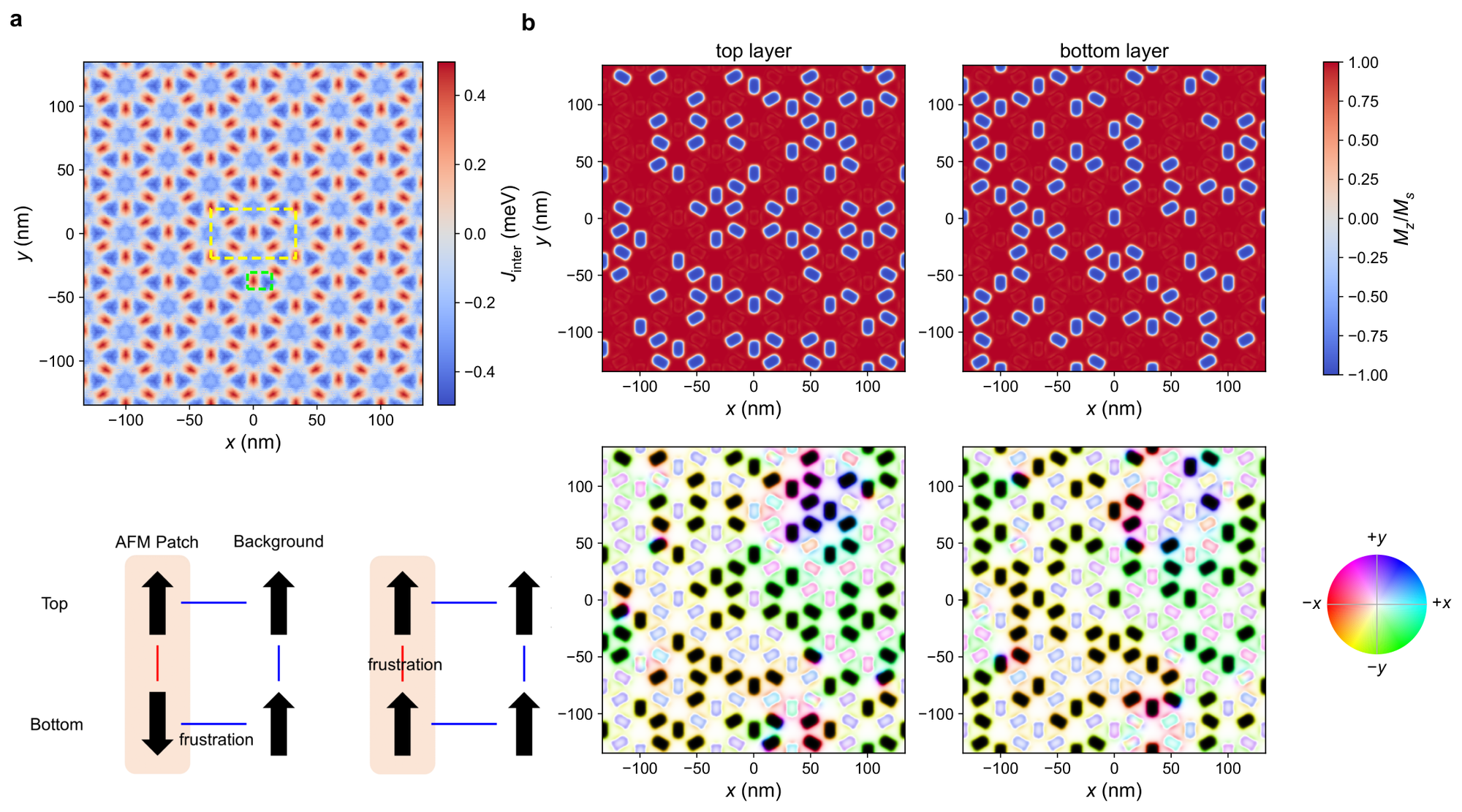
The level of unpredictability was quantified by something called "finite-time Lyapunov exponents," which are measures of how quickly small differences grow. The numbers were substantial, revealing just how sensitive this twisted system is. And when they ran statistical analyses, the resulting magnetic patterns were random and showed no correlation with each other. It’s a purely microscopic, undriven chaos, emerging from the very fabric of the material itself.
This changes our understanding of magnetic chaos significantly. For decades, the focus has been on driving chaos from the outside. Now, we know that simply twisting two magnetic layers can turn a material into a chaotic powerhouse. It suggests that material engineering, the deliberate shaping and twisting of two-dimensional magnets, could be a pathway to designing systems with inherent, complex, and nonlinear dynamics.
Maybe someday, this understanding of internal chaos could help us design new kinds of memory or computing devices, or even systems that can generate random numbers on demand, right there in the twisted layers of a simple material. For now, it’s a stunning reminder that sometimes, the greatest surprises aren't found by kicking something hard, but by looking closely at the subtle, internal squabbles in the weirdest corners of reality. And then, letting the chaos just happen. ◆
Sourced from: "Emergence of moiré magnetic chaos in twisted bilayer CrI3" by Gyuyoung Park, OukJae Lee, and Kyoung-Min Kim