

The universe, it turns out, is full of tiny, impatient dancers. Specifically, electrons, perpetually itching to move, to jump, to interact. And sometimes, we scientists like to hit a material very hard with a laser just to see how these electrons react, almost like thumping a wall to hear what's inside.
What comes out is often stranger than the wall itself. Imagine shining an intense beam of light through a solid crystal. You might expect some light to pass through, maybe change color a little. Instead, the material, when zapped just right, starts ringing out with bursts of light at much, much higher frequencies than the light you put in. Not just one or two steps up the frequency ladder, but twenty-three steps up. This seemingly impossible feat is what we call high harmonic generation, and it's less like playing a single note and more like a whole orchestra hitting every harmonic possible at once, instantly. For a long time, researchers have used this trick, this technique, to peek at electrons moving at speeds so mind-bogglingly fast we measure them in attoseconds—that's a billionth of a billionth of a second. But there's a special class of materials, called Mott insulators, that have always been a bit of a puzzle. These are materials where electrons, despite being plentiful and having plenty of space to move, just. don't. They're locked in place, held captive by their intense dislike of each other. These strong, persistent shoves and pulls between electrons are known as many-body interactions, and they make electrons behave more like a single, unified, stubborn crowd than individual particles. Understanding these crowded electron dynamics has been like trying to map a mosh pit in the dark.
But a recent study cracked open that mosh pit. Mingyao Guo and colleagues, in a preprint appearing on arXiv, turned their ultra-fast lasers on a prototypical Mott insulator, a compound called La₂CuO₄. They wanted to see if they could make those stubborn electrons dance, and more importantly, how their unique crowd behavior would show up in the emitted light.
And dance they did. The team observed high harmonic generation up to the 23rd order, meaning the material was spitting out light at frequencies twenty-three times higher than the laser light they used to excite it. But the really fascinating part wasn't just that they got light out, but how it behaved. They noticed something peculiar: the energy of the emitted light always hit a firm ceiling, an unyielding 4 electron-volt cutoff. It didn't matter how much harder they zapped the material; the highest energy light it produced remained fixed.
This fixed energy ceiling is a big deal. It tells us that this limit isn't just about how powerful the initial laser zap is, but about something fundamental within the material itself. It's like trying to make a bell ring louder and louder, but no matter how hard you hit it, it still only produces notes up to a certain pitch. That pitch, in this case, comes from the material's internal architecture, specifically from unique energy levels within the strongly interacting electron system, sometimes called Hubbard bands. These bands define the available energetic pathways for electrons, and apparently, there's a speed limit.
Then came the truly clever bit. The researchers didn't just hit the material once; they hit it twice. First, a quick, gentle flash of light to temporarily alter its properties—a process they call photo-doping. This initial flash was enough to create a few extra mobile electrons. Then, a fraction of a second later, they hit it with the main, intense laser pulse to induce high harmonic generation.
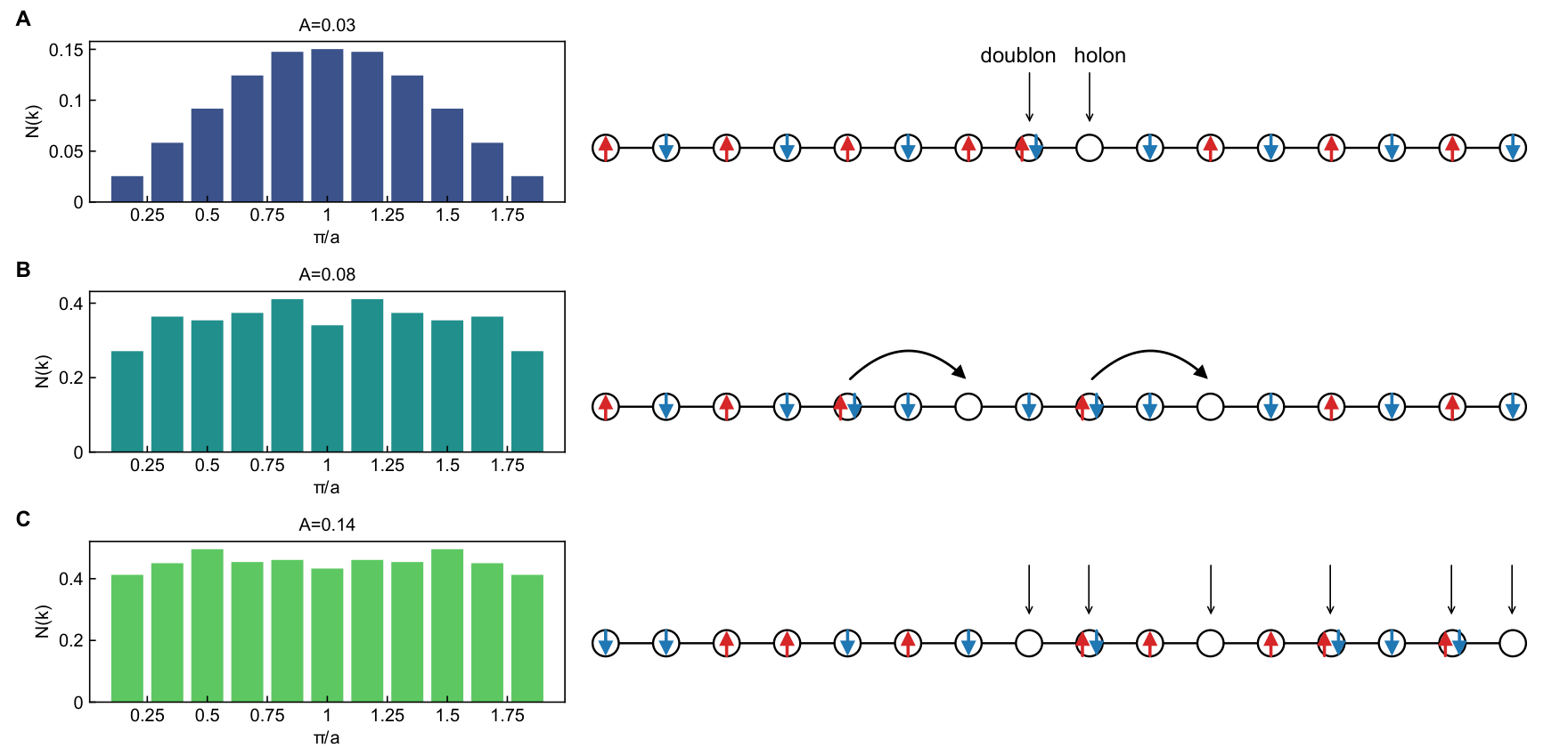
What happened next was startling. When they photo-doped the Mott insulator before the main laser pulse, the high harmonic generation was significantly suppressed. It wasn't just a little dimmer; it was almost like the material stopped singing. This wasn't some simple dampening. The initial light flash had caused a profound reorganization of the electron crowd, a many-body band reconstruction. This meant the entire landscape of energy pathways available to the electrons had shifted, fundamentally changing how they could move and interact. And that shift, that deep electronic structural change, directly imprinted itself onto the harmonic emission, essentially silencing the electron's usual high-frequency chorus.
This discovery moves high harmonic generation beyond just being a measurement tool. It shows it can be an incredibly sensitive probe, a sort of quantum X-ray vision, capable of detecting and even controlling the most subtle electronic reconstructions driven by these many-body interactions. Imagine being able to fine-tune the behavior of electrons in a material just by nudging them with light, altering their collective dance so profoundly it changes how they emit light.
The study of these strongly correlated materials and their extreme nonlinear optical responses is still in its early stages. But this work highlights a future where we might not just understand these complex electron systems, but actively manipulate them. We're learning to conduct the invisible orchestra within matter, making electrons dance to our tune, and in doing so, uncovering secrets that make the universe a far stranger, and more interesting, place than we ever imagined. ◆
Sourced from: "Dynamical many-body control of high harmonic generation in a Mott insulator" by Mingyao Guo et al.