
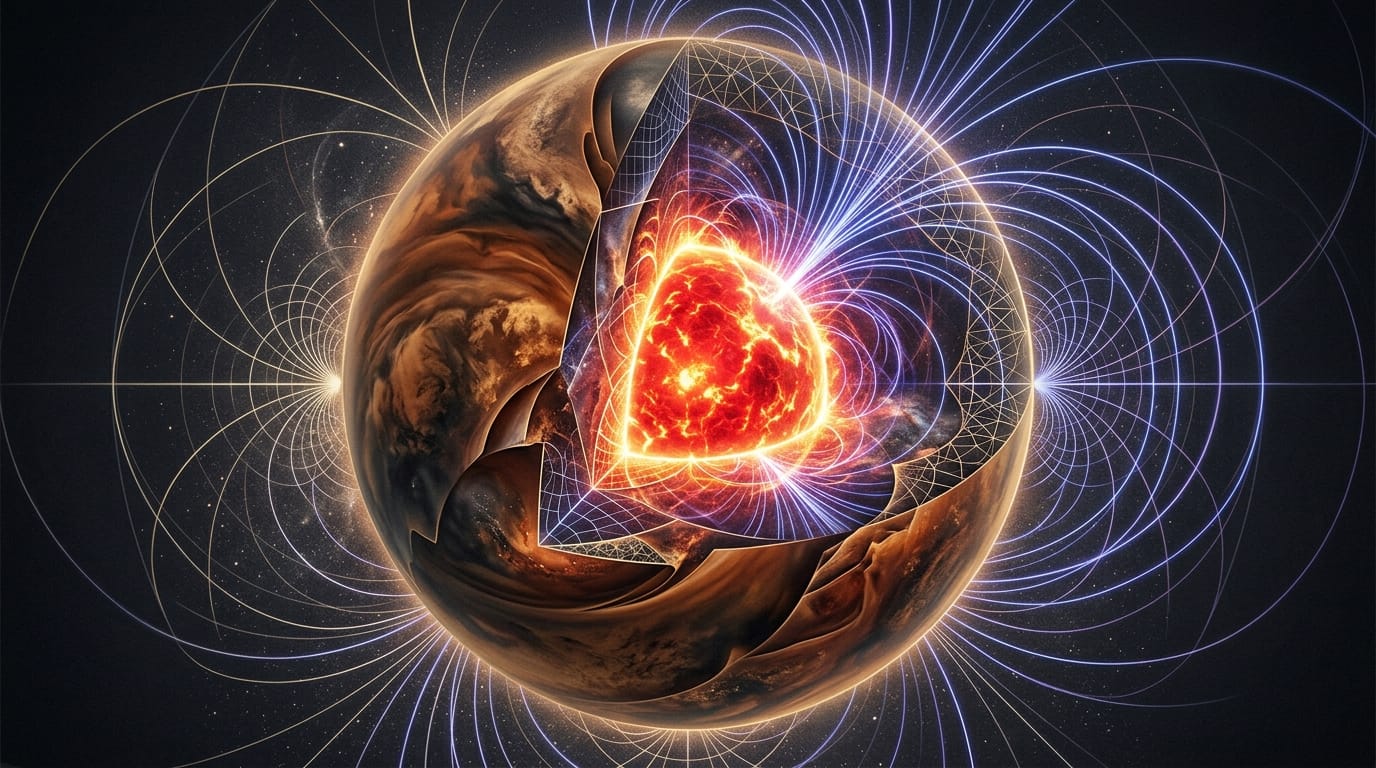
Earth’s magnetic field shields us. It guides compass needles, protects our atmosphere from solar wind, and shapes the aurora. This vast, invisible force arises from the churning of molten iron deep within our planet, a process known to scientists as a dynamo. Not merely a mechanical device, a dynamo describes how the motion of an electrically conducting fluid can sustain a magnetic field, sometimes even strengthening it.
For decades, mathematicians and physicists have puzzled over a particular kind of dynamo, one that operates with striking efficiency. These are called fast dynamos. A fast dynamo is a flow that can amplify a weak magnetic field into a strong one, and do so independently of how electrically conductive the fluid is. This quality makes them particularly relevant to many cosmic settings, from planetary cores to galaxies, where fluids can be highly conductive. The question of whether such dynamos could exist in smooth, self-sustaining fluid flows has remained a persistent theoretical challenge, known as the Fast Dynamo Conjecture. It asks if a fluid moving in a steady, predictable way could actually maintain a magnetic field, keeping it from simply fading away.
Now, a precise mathematical construction suggests an answer. Michele Coti Zelati and colleagues, in a preprint appearing on arXiv, have found a way to build these elusive dynamos. They describe specific fluid motions, characterized as smooth autonomous divergence-free velocity fields, within a particular mathematical space known as a three-torus.
Imagine space as not infinitely extending, but as something that loops back on itself. A flat sheet of paper, if you glued its top edge to its bottom edge and its left edge to its right edge, would become a donut's surface—a two-torus. A three-torus is a generalization of this idea, a conceptual space where movement in three distinct directions always brings you back to your starting point, as if you were forever moving inside a chamber that continually folds in on itself. Within this contained, repeating space, the team investigated fluid flows that are smooth, meaning they have no sudden breaks or sharp corners, autonomous, meaning they govern themselves without external time-dependent forces, and divergence-free, meaning the fluid does not compress or expand; it only moves.
Their construction unfolds in distinct stages. First, the researchers began with fluid movements that were periodic in time. These motions used a specific sequence of actions: stretching, folding, and shearing. Picture a baker kneading dough, pulling it, folding it over itself, then sliding parts of it past each other. This stretch-fold-shear mechanism, applied to a large variety of velocity fields, is known to be effective at generating magnetic fields that grow over time. The challenge was to move from these time-dependent, periodic actions to a self-sustaining, autonomous flow.
To achieve this, the team transformed the periodic dynamics into a steady, self-governing flow. They did this by using what mathematicians call a global Poincaré section, a way of reducing a continuous flow to a snapshot in time. Think of watching a complex machine, then only noting its state each time a particular part passes a certain point. Combined with a precisely defined return-time function, which dictates how long it takes for the flow to cycle back to a similar state, they could make these complex, field-generating motions happen continuously within a stable, non-changing fluid pattern.
The proof required isolating specific unstable patterns within the fluid’s motion. These patterns, like hidden channels where the magnetic field can grow, are known as unstable distributional eigenmodes for the ideal induction operator. The scientists showed that this instability, essential for a fast dynamo, persisted even when small, singular perturbations were introduced. This meant the dynamos they constructed were not fragile mathematical curiosities; their ability to generate fields remained resilient even with tiny changes, confirming the stability of their findings. The calculations proved consistent as specific parameters approached zero and remained steady under changes to the velocity field itself.
The Fast Dynamo Conjecture, a question posed by physicists Yakov Zeldovich and Andrei Sakharov, thus finds a resolution. The work of Michele Coti Zelati, Massimo Sorella, and David Villringer demonstrates that specific, smoothly flowing fluids, contained within a particular mathematical geometry, can indeed act as efficient, self-sustaining generators of magnetic fields. It confirms that the underlying structure of reality allows for such a delicate interplay between fluid motion and magnetic amplification, a dynamic that underpins much of the observable universe. This mathematical discovery, born from careful attention to abstract flows, reveals the deep currents that move through the heart of distant stars and our own spinning world, making visible a hidden order in the cosmos. ◆
Sourced from: "Smooth autonomous fast dynamo action on the three-torus" by Michele Coti Zelati, Massimo Sorella, and David Villringer