
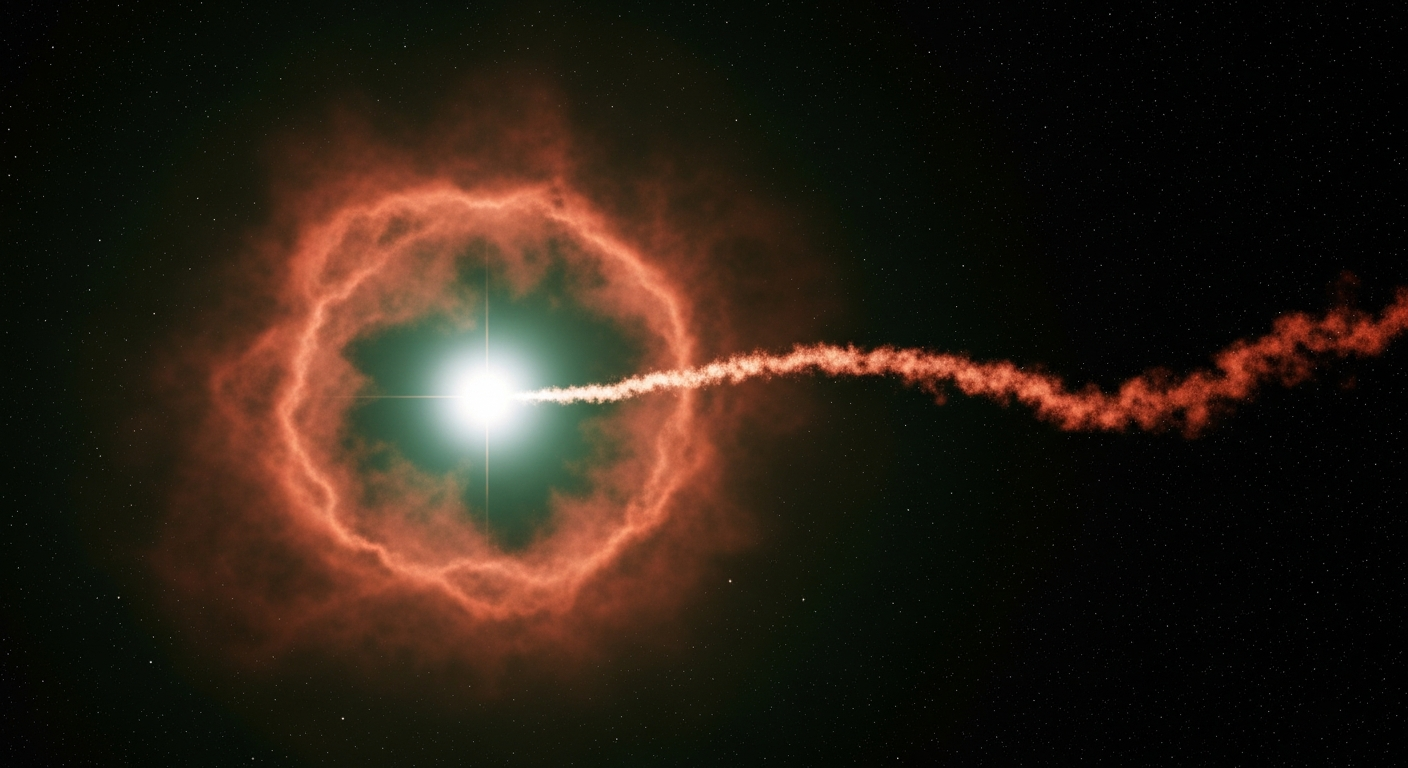
Millions of years ago, the light from Supernova 2026sqf began its journey towards us, a faint signal from a galaxy known as NGC 3310, which hangs some 49 million light-years distant in the constellation Ursa Major. This particular signal, however, bore a secret not only of a star’s final moments but also of its living. It carried within its oldest photons the shape of a life lived, and the precise circumstances that led to its destruction.
When a star reaches the end of its life, it casts off layers of gas and dust into the vast dark around it. When such a star explodes, becoming what astronomers call a supernova, this ejected material sometimes acts as a kind of cosmic fossil, a record of the star’s history. For Supernova 2026sqf, this record suggests an unusual kind of stellar death, one where a star’s self-destruction was profoundly shaped by a close companion.
Scientists classify Supernova 2026sqf as an SN Ia-CSM, a rare subclass of thermonuclear supernovae. A thermonuclear supernova occurs when a dense, burnt-out star remnant known as a white dwarf pulls too much material from a neighboring star, igniting a runaway fusion reaction within itself. What makes the SN Ia-CSM subclass particular is the interaction of the supernova blast wave with the gas and dust that surround the exploding star, called the circumstellar medium. This surrounding material, which acts as a shroud, leaves its own distinctive marks on the light astronomers observe. If confirmed, Supernova 2026sqf would be the closest known example of this uncommon type of stellar demise, bringing us a clearer view of its mechanics.
To understand these far-off events, scientists carefully examine the light. They break apart this light, much like a prism splits sunlight into a rainbow. Each color, each specific shade, carries a message about the star’s composition and temperature. This is how they analyze its spectrum. They also track how a star’s brightness changes over time, creating a graph known as a light curve. The distinct shapes of these spectra and the evolving brightness tell a detailed story.
Through this meticulous work, Tamás Szalai and his colleagues describe findings in a preprint appearing on arXiv that shed new light on the origins of these rare stellar explosions. They analyzed the early-phase spectra and light curves of Supernova 2026sqf, paying close attention to the way the star’s light changed in the immediate aftermath of the explosion. What they found suggested a specific kind of past.
This research marks a significant step, as it presents the first candidate progenitor system for a thermonuclear supernova ever identified using pre-explosion imaging from the James Webb Space Telescope, or JWST. A progenitor system refers to the specific stars, or combination of stars, that eventually lead to a supernova. The JWST, with its infrared capabilities, offers a view into the dusty environments where stars form and die, often obscured from other telescopes.
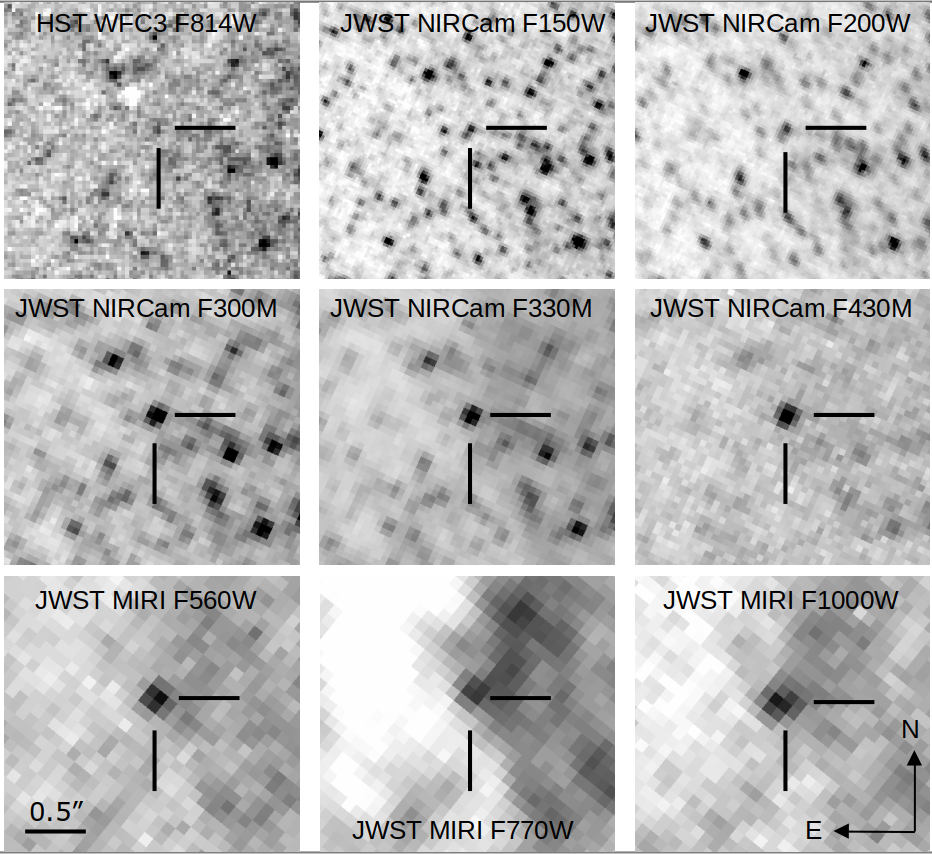
The telescope’s observations showed a white dwarf interacting with an old, large star nearing the end of its life, known as an AGB star. Here, the two stars were likely in a common-envelope phase. This means they orbited so closely they effectively shared an outer atmosphere, like two eggs encased in a single, vast, shimmering shell of gas. This intimate arrangement, the researchers suggest, created the conditions for the observed supernova.
The material surrounding Supernova 2026sqf — the circumstellar medium — held further clues. Its properties were consistent with material expelled by an AGB star. Yet, the characteristics of the observed light, particularly the width of certain emission lines, indicated that this material was not streaming off in a continuous, gentle outflow, but rather in bursts. This episodic ejection points to a complex dance between the two stars, a binary interaction that likely occurred shortly before the white dwarf exploded.
The findings offer the first evidence for a probable carbon-rich AGB star serving as the donor, supplying material to the exploding white dwarf. This detail helps to refine our understanding of the specific types of stellar systems that give rise to these unusual supernovae.
It must be noted that this classification of Supernova 2026sqf as a Type Ia-CSM supernova is not yet fully confirmed, and the precise process and timing of the binary interaction that preceded the explosion remain unknown. Future observations, especially with the JWST, will be vital to verify these initial insights from the early-phase analysis. Even so, the initial gaze through the JWST has peeled back a layer of cosmic dust, allowing us to see not just the immediate aftermath of a star’s death, but perhaps even the ghost of its prior life, whispering of a shared past and a violent end. It reminds us that every flash in the night sky is a long story, carefully told through light. ◆
Sourced from: "JWST Detects a Dusty AGB-like Source Before the Type Ia-CSM Supernova 2026sqf" by Tamás Szalai et al.