
Whispers from the universe carry its secrets, but often, a roaring static drowns them out. Imagine trying to hear a faint, distant melody through the din of a crowded city. That’s the monumental challenge facing scientists who search for things like ultralight dark matter, which might manifest as tiny, oscillating shifts in space-time, or the elusive joint sources of high-energy neutrinos and gravitational waves from violent cosmic events. The signals are there, buried deep in vast torrents of data, often too faint for even our most sophisticated classical instruments to pick out clearly.
For decades, researchers have built larger, more sensitive detectors, pushing the boundaries of what classical physics can achieve. They’ve also dreamt of quantum computers, machines that promise to revolutionize everything from medicine to materials science. The challenge, however, has always been the sheer scale of these dreams. Many of the most powerful quantum advantages require processing capabilities that are still far beyond what today’s experimental setups can deliver. It seemed like the universe would have to wait for truly revolutionary insights. But imagine gaining a significant advantage without needing a sprawling quantum supercomputer. What if a single, precisely controlled quantum building block could dramatically improve how we extract meaning from the static? This was the question that nudged Ishaan Kannan and colleagues towards a surprisingly elegant solution, appearing on arXiv. They weren't aiming to build the biggest quantum machine, but rather the smartest little one, designed to solve a very specific, deeply persistent problem: learning classical signals more efficiently. Think of a quantum bit, a qubit, like a traditional light switch that can be on or off. But unlike a regular switch, a qubit can also be in a state of being both on and off at the same time, a shimmering possibility until you look at it directly. This unique property, among others, gives quantum systems their strange power. The team’s core insight was to couple one of these remarkable qubits not to another complex quantum system, but to an otherwise ordinary, conventional sensor.
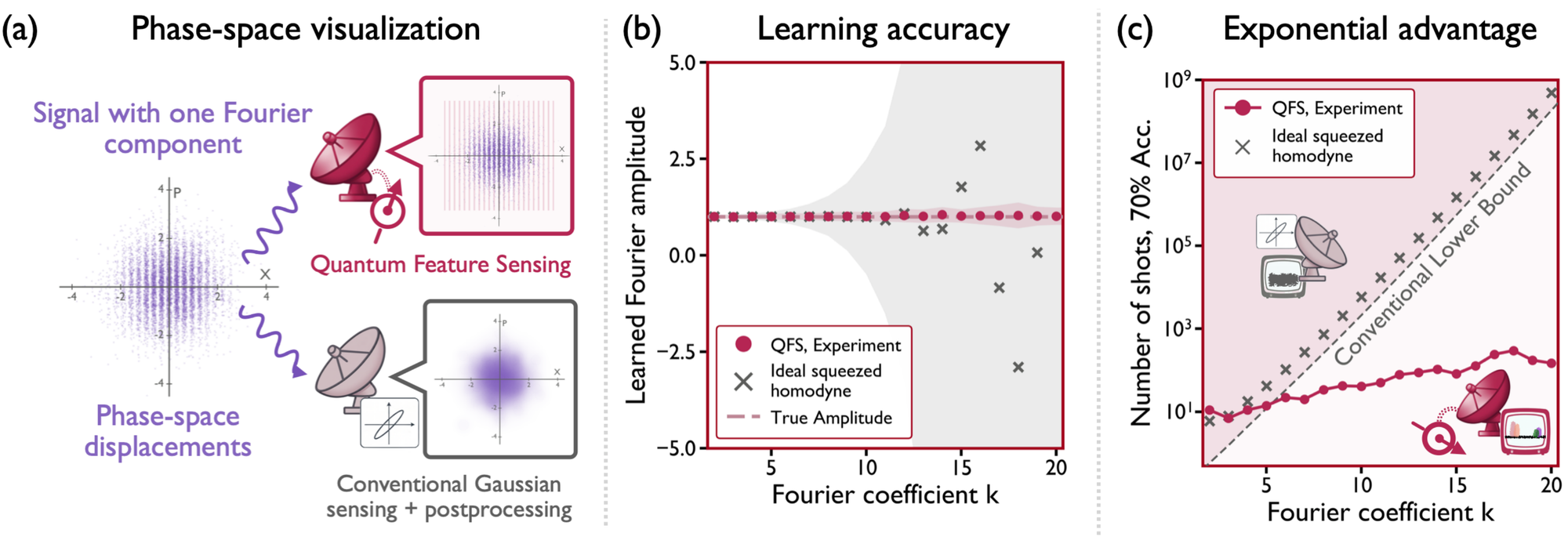
Their goal was to drastically cut down the number of measurements needed to understand incoming information. Imagine a radio signal: it’s a jumble of different frequencies, changing rapidly over time. To fully understand it, classical methods require countless observations, painstakingly piecing together its hidden patterns. Kannan and his team developed algorithms they called "quantum feature sensing." These algorithms use the subtle quantum states of their single qubit to essentially 'taste' the incoming classical signal, extracting crucial information about its component frequencies and how it varies over time with far greater efficiency.
They put their idea to the test in a specialized, ultra-cold setup, carefully engineered to protect and manipulate a single qubit integrated with a sensor. The results were nothing short of astonishing. They experimentally demonstrated that this simple coupling — a single controllable qubit linked to a conventional sensor — could reduce the number of measurements needed for learning complex signals that fluctuate over time, or those composed of many different frequencies, by a staggering 10 million-fold. This wasn't a theoretical prediction; this was an observed, exponential quantum advantage for learning classical signals, delivered by a single qubit.
Guiding their exploration was a novel theoretical framework they developed called Quantum Phase-Space Inference, or Q\Psi. This wasn't just a clever label; it provided a systematic roadmap for identifying where and how quantum approaches could truly offer a rigorous advantage in practical tasks, showing them precisely how to build optimal quantum learning algorithms. It’s like having a compass that points directly to the most fruitful applications of quantum mechanics, even when working with minimal resources.
This isn't about replacing every classical sensor. Instead, it’s about making them vastly more efficient, turbocharging their ability to make sense of the world. The implications ripple outwards, touching fields where faint signals and mountains of data are the norm. Imagine observatories like LIGO, Virgo, KAGRA, and IceCube, tirelessly searching for gravitational waves and high-energy neutrinos. Identifying these fleeting cosmic events means sifting through noisy data where individual signals are often too weak to register on their own. Quantum-enhanced analysis could now fuse these disparate data streams, spotting the whisper of a common origin where before there was only static.
Similar advantages could emerge in the search for ultralight dark matter, where tiny shifts in detector readings demand extreme precision, or in high-energy particle physics, where scientists meticulously comb through collision data for the rarest of decays. The universe's faint signals, once obscured, might soon come into sharper focus. This work shows that near-term quantum technology, even in its most minimal form, holds the power to transform how we perceive and understand the vast, noisy cosmos around us, making its whispers sing a little clearer. ◆
Sourced from: "Exponential quantum advantage for learning signals with a single qubit" by Ishaan Kannan et al.