
Imagine trying to draw a perfect circle, but your hand jitters slightly and you can't tell exactly how much. In quantum physics, experiments demand extreme precision. Tiny, unseen shifts can ruin an observation, especially when light interacts with individual quantum particles. We rely on light to probe and manipulate these systems, but the exact way light influences a particle – its 'interaction phase' – must be known with extreme accuracy. If these phases are unknown or shift unpredictably, it's typically impossible to see the subtle patterns of quantum behavior.
The key thing here is quantum interference. Think of a ripple spreading across a pond: if two pebbles drop, the ripples meet, some adding up, others canceling out. Particles in the quantum world also behave like waves, and are capable of interference. Observing this is fundamental to understanding their properties and building new technologies. But doing so usually requires knowing the exact timing of all the 'ripples.' If those interaction phases are stable but unknown, detecting interference in complex quantum states becomes a monumental, almost impossible task. This challenge has long been a roadblock, making active control necessary for exploring complex quantum states. Without it, observing interference in states more complicated than a single particle has been out of reach.
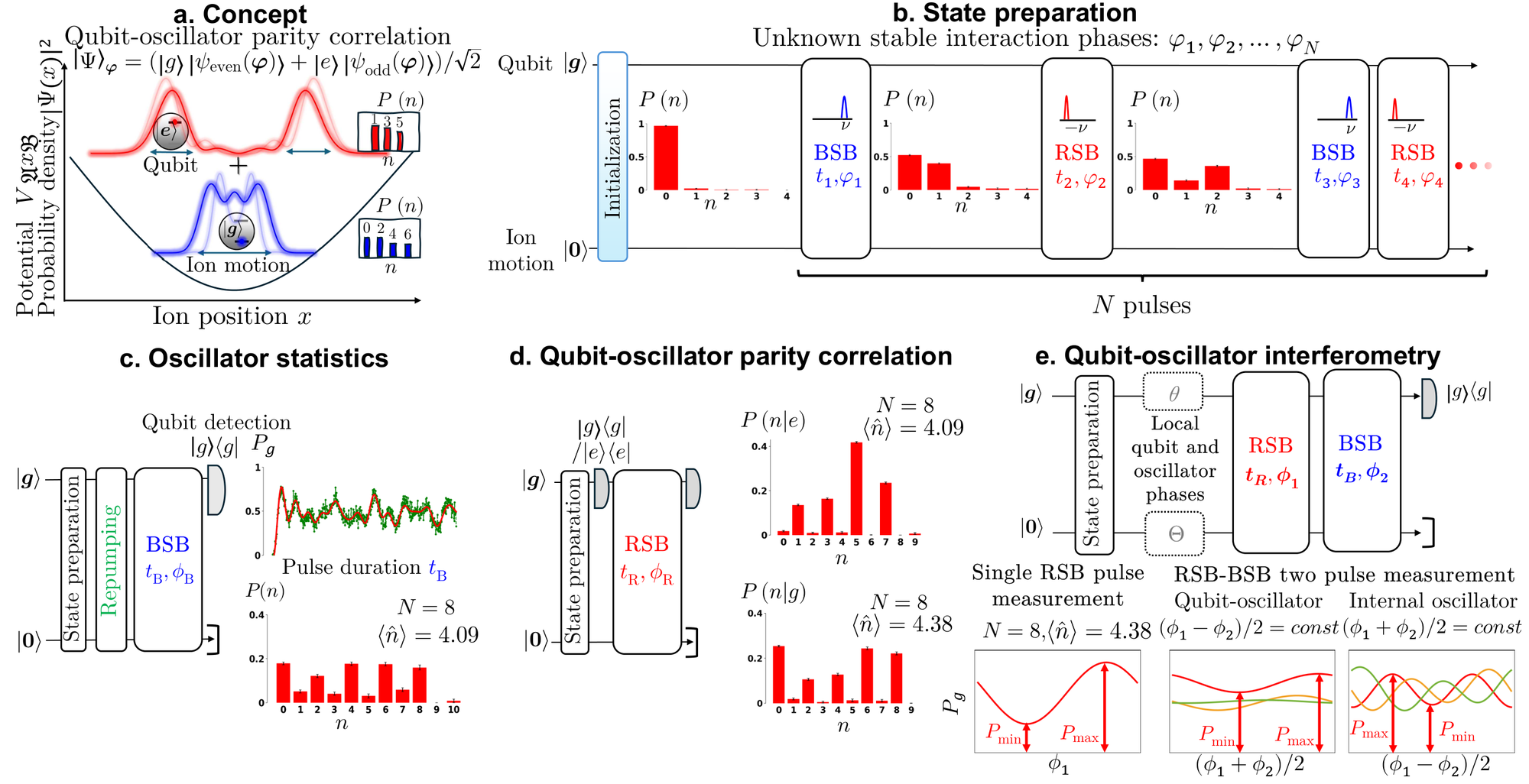
Now, with that foundation established, consider a recent breakthrough. A team including Kratveer Singh and colleagues, writing in a preprint appearing on arXiv, found a way around this limitation. They demonstrated a type of quantum interference that ignores stable, unknown interaction phases. They achieved this by cleverly designing their experiment so the act of seeing interference became resistant to these uncertainties. To achieve this, researchers used a single calcium ion, held by electromagnetic fields. This ion has internal properties, like an electron's spin, that can be in one of two states—a qubit. It also has motion, jiggling back and forth in its trap. The key insight was linking the ion's internal 'switch' to its motion. They created a special quantum state where the qubit was connected to its movement. Imagine a tiny ball jiggling in two opposite directions simultaneously, its motions tied to its internal properties. This link set the stage.
They then shone specific light pulses onto the ion, tuned to interact in two distinct ways. By applying these pulses in an alternating pattern—first one, then the other—they enforced a particular correlation. This forced the ion's internal state and its motion to be tightly bound, even if external influences introduced uncertainty.
The experiment used a very simple, two-step sequence of these light pulses. This minimal approach means fewer opportunities for errors. Despite the simple setup, they observed clear 'qubit-parity interference.' This interference tells us whether the number of excited 'qubits' in a system is even or odd, crucial information about its quantum state.
The results were striking. They first demonstrated qubit-parity interference with a characteristic visibility of 20%. Visibility measures how clear and distinct an interference pattern is—how much waves add up and cancel out. Higher visibility means stronger evidence. Through refinements, they improved this to 40%, approaching the theoretical maximum. This confirmed their method worked.
This work changes how we study and use complex quantum systems. As these systems grow, fully understanding their precise state becomes exponentially harder. Researchers usually do this through 'state tomography,' making many measurements to piece together a complete picture. For systems with many entangled parts, state tomography quickly becomes impractical, like trying to photograph every ripple on a vast ocean at once.
This new qubit-parity interference method detects a critical aspect of complex quantum states—what we call 'coherence'—without needing to reconstruct the entire picture. Coherence is a quantum system's ability to maintain its wave-like properties and show interference. For scientists building robust quantum computers or incredibly sensitive quantum sensors, confirming coherence in 'high-dimensional quantum states' (states involving many interacting quantum properties or particles) is essential. Doing so with a simple, two-pulse sequence, bypassing full state tomography, makes this approach powerful and scalable.
This research, led by Kratveer Singh and his team, removes a significant hurdle for quantum technologies. It allows researchers to measure fundamental quantum properties even when the usual controls aren't perfectly adjusted. This points to a future where we can build quantum systems that are more powerful and forgiving of experimental imperfections. It opens new avenues for exploring intricate quantum phenomena, much like learning to read the messages in those complex ripples without needing to know the exact starting point of every dropped pebble. ◆
Sourced from: "Qubit-parity interference despite unknown interaction phases"