
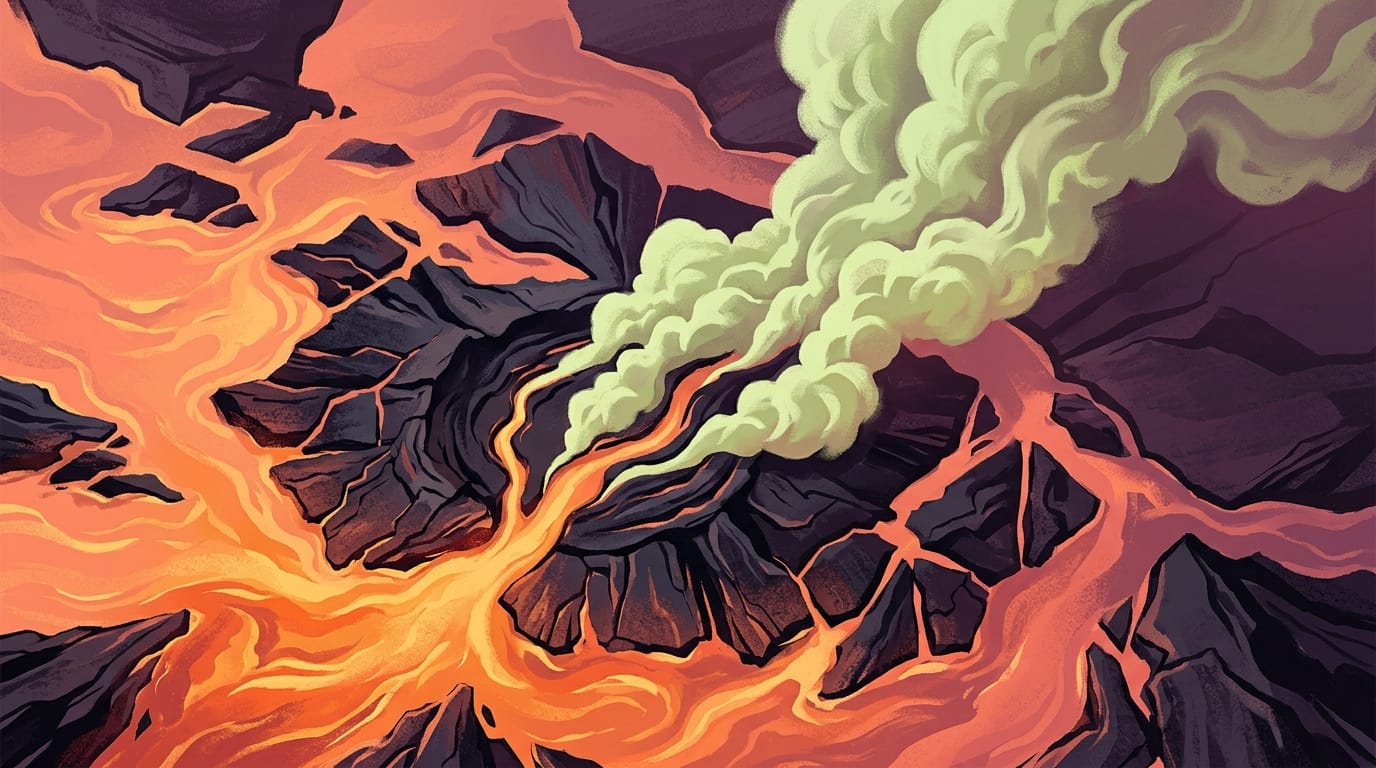
Imagine a planet so close to its star that its surface remains a permanent ocean of molten rock. Such planetary environments are not distant, theoretical ideas; worlds orbiting very near their stars are real, and some likely exist at temperatures high enough to keep their entire surfaces in a liquid, incandescent state. Such a planet truly sits at the intersection of extreme geology and atmospheric chemistry, with its deep interior processes directly influencing the thin veil of gas surrounding it, if any. Understanding the fate of a planetary atmosphere when the ground beneath it is a churning, glowing sea of magma becomes a central challenge. This is precisely the puzzle that Mariana Sastre, Tim Lichtenberg, Lisa Dang, and their colleagues set out to explore. In a preprint appearing on arXiv, these researchers present a detailed look at the likely thermal evolution of these lava planets, predicting how their temperatures change over vast spans of cosmic time. Their work helps us understand what kinds of atmospheres such extreme worlds might maintain or lose. We know that the interactions between a molten planetary surface and the gases released from it can either help an atmosphere persist or contribute to its gradual escape. For any atmosphere to survive the intense radiation from a nearby star, there must be a minimum limit for atmospheric gas loss, a point below which gases simply don't have enough energy to flee into space.
To make these predictions, Sastre and her team used a sophisticated computer model that intricately links a planet's deep interior processes with its atmospheric conditions. This model, which they call the PROTEUS framework, allowed them to build a comprehensive set of simulations. They modeled various scenarios for these planets, focusing specifically on five exoplanets already identified as targets for a particular observation program using the James Webb Space Telescope. These five worlds—TOI-1807 b, TOI-2260 b, TOI-431 b, TOI-6255 b, and TOI-2431 b—will soon be scrutinized for signs of their atmospheres.
The outcomes from the simulations fell into six distinct categories, each defined by how much of the planet’s interior remained molten and whether it held onto a detectable atmosphere. What the models actually showed is that most of these lava planets are predicted to ultimately become what scientists call "bare-rock planets." This means they would end up with very little molten rock left in their interiors—less than 20 percent of their mass—and no substantial atmosphere. The ability of these worlds to hold onto an atmosphere, the models indicated, relies heavily on how efficiently gases escape into space. The researchers were able to establish that minimum limit for atmospheric gas loss, below which a planetary atmosphere can indeed survive even on these irradiated, rocky worlds.
Perhaps the most interesting prediction, however, involves a specific atmospheric gas: sulfur dioxide. The models showed that for most atmospheric gases, their predicted concentrations were higher when a planet's surface was molten, and it held a significant atmosphere. This makes intuitive sense: a molten surface would release more gases. But sulfur dioxide (S2) behaved differently. Its presence was actually enhanced when the planet's surface had solidified. This finding suggests a powerful possibility: the amount of sulfur dioxide we might detect in a lava planet's atmosphere could serve as a direct clue about whether its interior is still a churning ocean of magma or if it has largely cooled and solidified.
It is important to remember that these are predictions, not direct observations. The work by Sastre and colleagues provides a careful roadmap for future studies. Their simulations offer crucial guidance for interpreting the upcoming James Webb Space Telescope data from those five specific exoplanets. Understanding the final state of these lava worlds—how much melt remains, and what kind of atmosphere they possess—requires a multi-target approach, examining planets at various stages of their thermal evolution. The predictions help astronomers know what features to look for and how those features might distinguish between different geophysical states. While we have yet to confirm these findings with telescopes, this kind of precise modeling allows us to anticipate what we might see. It directs our gaze, pointing to sulfur dioxide as a surprising chemical messenger, whispering secrets from deep within these fiery alien worlds. ◆
Sourced from: "Thermal Evolution of Lava Planets Across System Ages: Predictions for Hell of a Survey" by Mariana Sastre et al.