
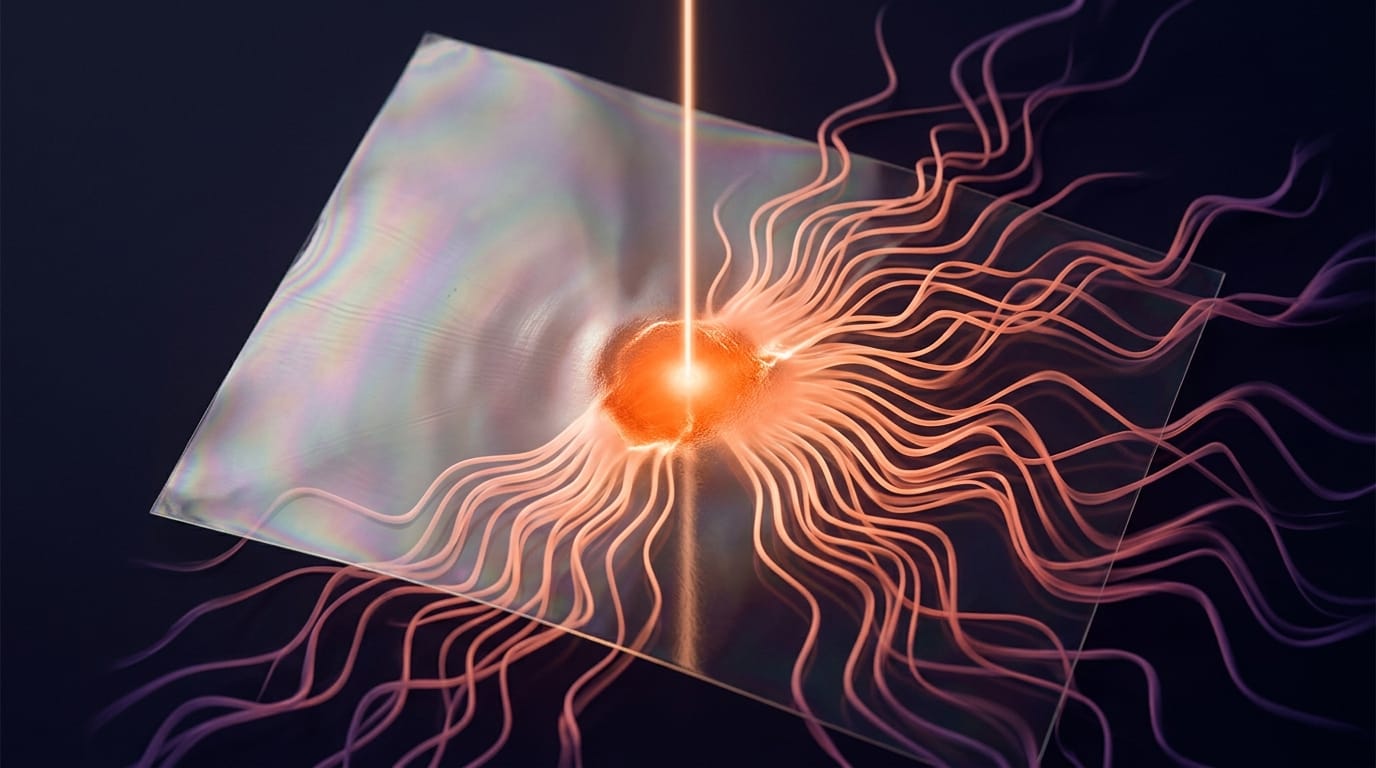
For years, the puzzle had lingered, a whisper of impossible speed in the world of optics. Scientists observing certain materials, called transparent conducting oxides—TCOs for short—kept noticing something baffling: these materials could change how they interacted with light with a swiftness that defied explanation. Light-induced shifts in their ability to bend light, their refractive index, occurred within a mere handful of femtoseconds. A femtosecond is an almost unfathomable sliver of time, to a second what a second is to about 31.7 million years. Crucially, these changes didn't just happen fast; they vanished just as quickly, often within 10 to 20 femtoseconds.
Conventional wisdom offered no easy answers. Most theories pointed to "phonons," the vibrations of a material's atomic lattice, as the agents of change. But even the quickest atomic jiggles simply couldn't move and reset on timescales that brief. This discrepancy left a gaping hole in understanding, a fundamental challenge to existing models of how light and matter interact. The mechanism, then, that could orchestrate such a fleeting, powerful transformation presented a profound mystery. The question compelled Jae Ik Choi and colleagues.org/abs/2412.24641) to look in a different direction. If the heavy atoms weren't doing the work, perhaps the nimble electrons were. They began to build a novel theoretical and computational framework, shifting their focus from the material’s structural vibrations to the microscopic ballet of TCO electrons when struck by powerful, ultra-short laser pulses. The new model offered a way to simulate how material properties, particularly the bending of light, could change at such extreme speeds. It was an audacious idea: the direct, rapid modulation of electron behavior, not slower lattice movements, held the key to these femtosecond optical alterations.
Their research, detailed in a preprint appearing on arXiv, didn't stop at theory. Choi and the team theoretically demonstrated that TCOs could do more than just change; they could exhibit "oscillatory and sign-reversing dynamic modulation in how much light passed through them, their transmittance. Imagine a window cycling through transparency levels, even momentarily reversing its optical behavior, all in a fraction of an eye-blink. This rapid, oscillating change in light transmittance was something entirely new, potentially clarifying those baffling, unexplained dynamics observed in earlier experiments.
To make these oscillations more pronounced and controllable, the researchers designed an ingenious system. They conceived of an "inverse-designed multilayer cavity—a stack of ultra-thin film layers precisely sculpted by computer models to guide light. At the heart of this cavity, they placed an ultrathin layer of a TCO. To make the TCO even more responsive, they added an "electron-acceptor layer to their meticulously designed cavity. This layer enables "thermionic carrier injection," using heat to nudge electrons into the TCO layer, priming it for hyper-responsiveness. The crucial insight, one that had eluded scientists for so long, became clear: "extreme electron temperatures were driving these fast, oscillatory responses. It wasn't that the entire TCO material was getting hot, but that the electrons themselves, the lightest, fastest particles, were being superheated, like tiny, hyperactive dancers. These extreme electron temperatures initiated a cascade of rapid, oscillating changes in the TCO's optical properties. This research, for the first time, demonstrated the critical role of electron temperatures in driving these oscillating dynamic responses.
The speed was truly astonishing. The research showed these transmittance oscillations had a characteristic period of approximately 20 femtoseconds. To put that in perspective, a common infrared probe beam (1.431 micrometers wavelength) completes about four of its own "optical cycles—one full ripple of a light wave—in that same 20 femtoseconds. Other observations showed a rapid change in the refractive index for an electron-acceptor layer, occurring as fast as 20 femtoseconds, corresponding to just three optical cycles for a different probe beam (1.8 to 2.0 micrometers). The changes were happening faster than a single ripple of the light wave itself.
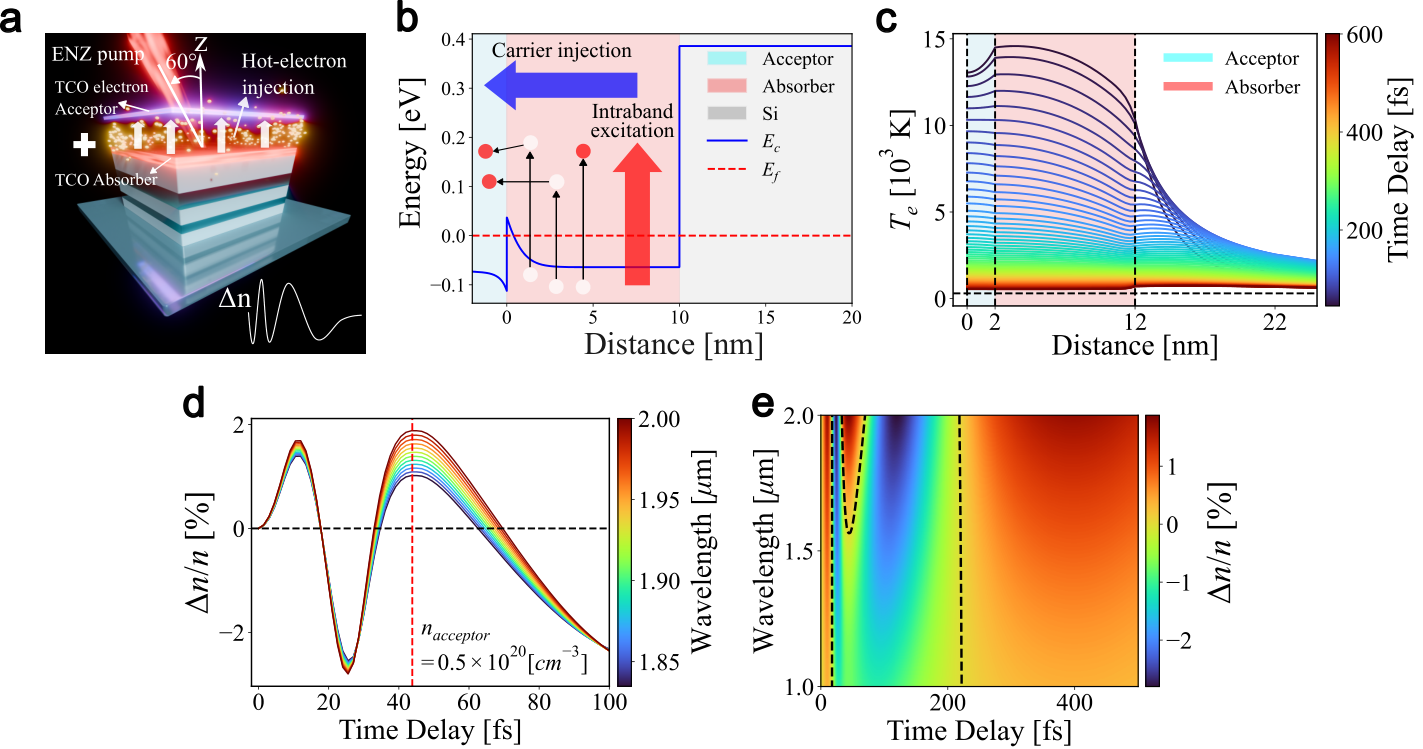
This wasn't just theoretical fancy; the model found experimental validation. Scientists observed what they called "intraband modulation of electrons within the conduction band—a phenomenon directly predicted by the new theoretical framework. Under the influence of powerful ultrafast laser pulses, electrons within the same energy band exhibited the predicted modulations, leading to the detectable, ultrafast oscillations in the material's refractive index. This confirmed the microscopic electron dynamics as the driving force behind these rapid optical shifts.
This fundamental understanding of how extreme electron temperatures rapidly impact TCOs ushers in a new era. Researchers are calling it "optical-cycle dynamic photonics," meaning the ability to manipulate light on timescales as fast as light itself vibrates. With the predictive power of this new theory, scientists can now design targeted experiments to create entirely new optical effects. Foremost among these is the potential to create "photonic time-crystals," structures where optical properties vary periodically in time, like a rhythmic, invisible switch, allowing unprecedented control over light. The implications stretch beyond basic science, promising significant advancements in reconfigurable optics, where lenses and mirrors could change shape instantly, and high-speed information processing, where data could be manipulated faster than ever imagined. The puzzle of the flickering TCOs, once a mystery of impossible speed, has revealed a universe of light moving to an impossibly fast beat. ◆
Sourced from: "Pathway to optical-cycle dynamic photonics: extreme electron temperatures in transparent conducting oxides"