
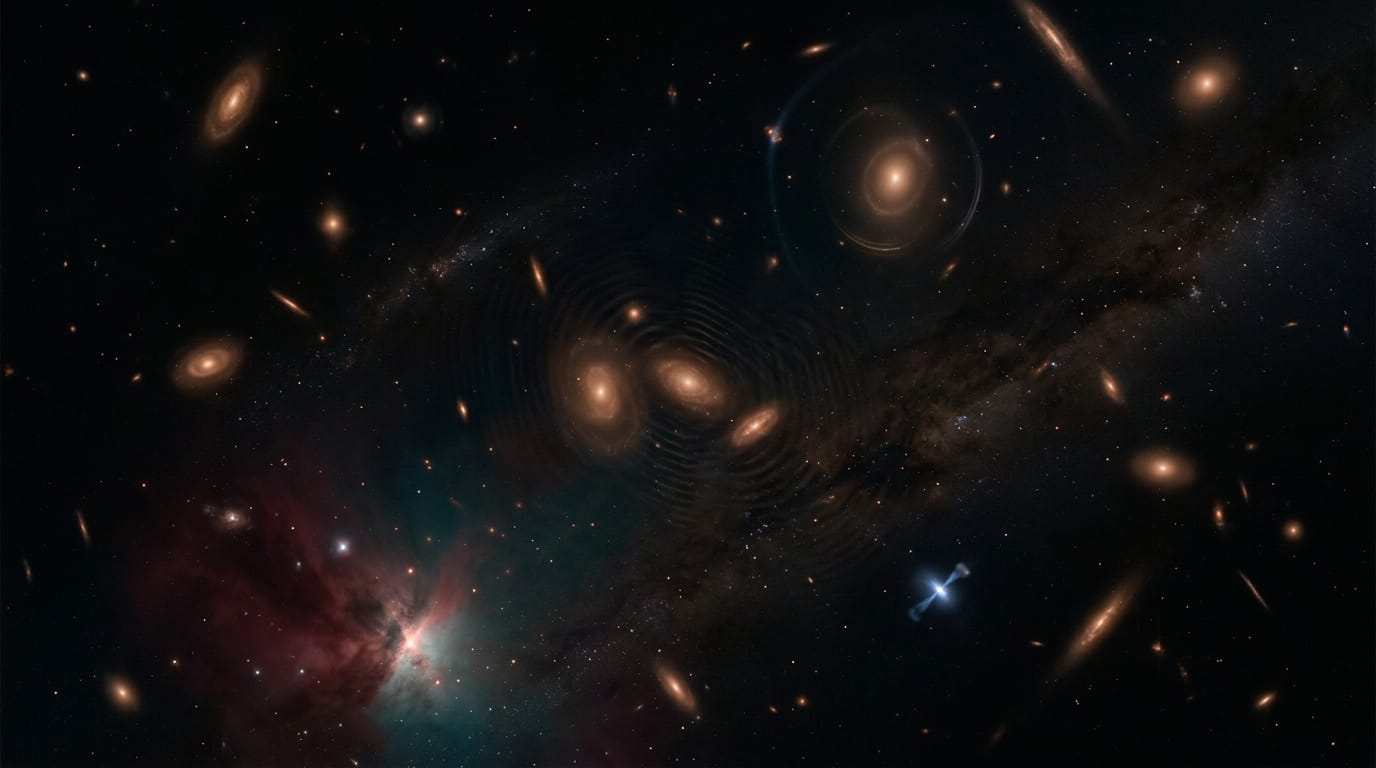
Faint tremors in the fabric of spacetime—gravitational waves that race across the cosmos—are the universe's most violent signals. These distortions are the echoes of extreme events, such as the collision of two black holes, each a relic of a collapsed giant star. When these immense gravity wells merge, more energy is released in a fleeting instant than from all stars in the visible universe combined, sending a ripple that travels for billions of years before reaching our detectors on Earth. We can hear these distant clashes, but the echoes do not tell us precisely where they happened.
We can chart the general direction from which a gravitational wave arrives, pointing to an area in the sky that might span hundreds of full moons. Within that vast patch, millions of galaxies reside, and finding the specific galaxy where a pair of black holes completed their final dance becomes a profound challenge. Pinpointing the actual home of such a merger is like knowing a particular pebble landed somewhere in an entire desert. This difficulty has long limited our understanding of where these merging black hole systems, these cosmic collisions of two immense gravity wells, originate. The physical environment of these events—the type of galaxy that fostered them—holds clues to how they formed, grew, and eventually found each other.
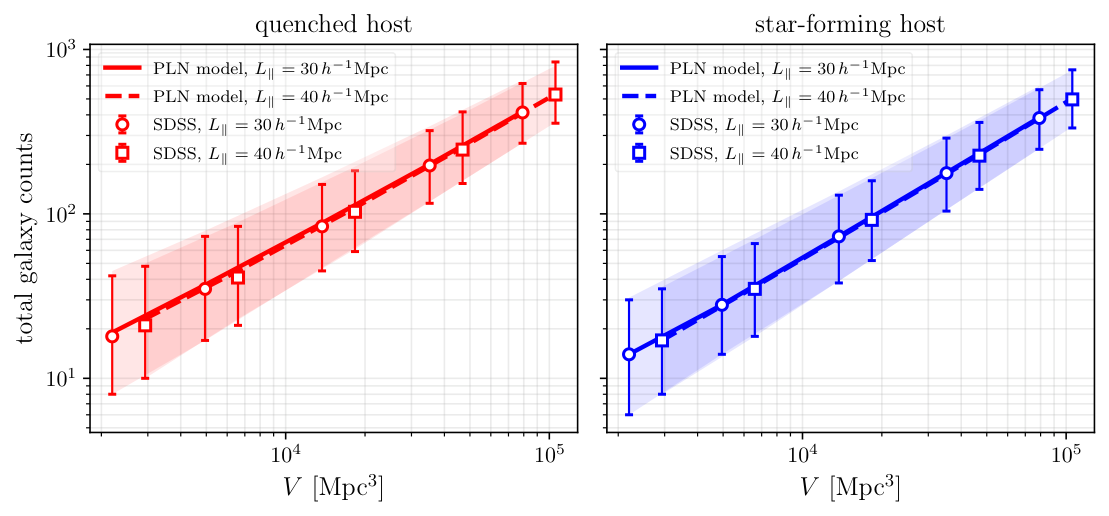
Yet, new attention paid to the subtle patterns of the universe may offer a path forward. Daiki Watarai and colleagues, in a preprint appearing on arXiv, describe a framework that infers the properties of these invisible host galaxies not by identifying them individually, but by carefully observing their galactic neighborhoods. Imagine trying to learn about a house by studying the types of houses around it, even if the house you care about is hidden from view. This approach uses how galaxies tend to cluster together, a pattern that changes based on the types of galaxies involved. The researchers constructed event-level likelihoods, which estimate the probability that a particular type of galaxy hosted a binary black hole merger. These likelihoods are built from patterns of how galaxies are distributed around different kinds of host galaxies within those broad gravitational-wave localization regions. Some galaxies are still vibrant factories, actively forming new stars. Others, known as quenched galaxies, have largely ceased this activity, their star formation slowed to a crawl. The way galaxies cluster differs between these populations. By studying the observed distribution of galaxies in a gravitational-wave event's sky patch, the team could infer the underlying type of host galaxy responsible for the merger.
This method carries a particular strength, requiring no prior assumptions about how efficiently black holes form or the time delays before their mergers. It simply uses careful measurements of how star-forming and quenched galaxies arrange themselves throughout the cosmos. This framework applies to both common and rare galaxy populations, a versatile tool for galactic detective work.
Understanding the connection between black holes and their host galaxies has long been a pursuit in astronomy. Surveys like the Sloan Digital Sky Survey and citizen science projects such as Galaxy Zoo have revealed that a galaxy’s structure and its history of star formation are intrinsically tied to its central black hole. For more than a decade, Galaxy Zoo has allowed people to classify countless galaxy images, providing crucial data that helps define whether a galaxy is star-forming or quenched. These classifications, gathered by human attention, become essential inputs for the statistical analysis Daiki Watarai and his team now employ.
The true power of this new method becomes clear when considering the gravitational-wave detectors of the near future. The researchers projected how well we might infer host-galaxy properties over a single year of observations. They assumed, for the purpose of demonstrating the method's capability, that all binary black hole mergers take place within quenched galaxies.
For the next generation of detectors, known as O5 networks, the forecasts indicate we could determine that at least 19 percent of these mergers occur in quenched galaxies. This number, 0.19, represents a robust lower limit on the fraction of mergers occurring in these quiescent systems.
For networks planned after O5, that lower limit rises significantly. The projection for these post-O5 networks is 48 percent, meaning at least 0.48 of all binary black hole mergers could be linked to quenched hosts.
For third-generation gravitational-wave networks, instruments that will peer deeper into the cosmic past, the forecasts are still more striking. Here, the lower limit on the fraction of mergers hosted by quenched galaxies reaches 92 percent. This figure, 0.92, suggests a future where we can be nearly certain the majority of these events take place in galaxies that have stopped actively forming new stars.
These forecasts mean that long before the most advanced gravitational-wave detectors are fully operational, we will already possess the means to infer the environments where binary black holes coalesce. This statistical approach, moving beyond the challenge of direct identification, represents a profound shift. It is a method with broad applicability, too, as similar techniques are beginning to provide insights into other cosmic transients, like Fast Radio Bursts, linking them to their host galaxies when direct pinpointing is difficult.
The universe does not always yield its secrets through simple sight. Sometimes, we must listen to the echoes, and with careful attention, decipher the patterns in the surroundings. What may seem like an empty stretch of sky, a blank canvas of distant light, reveals itself as a landscape of subtle relationships and hidden histories. The world, older and stranger than we often allow ourselves to remember, continues to speak in whispers, waiting for us to learn its language. ◆
Sourced from: "Galaxy Clustering Can Reveal Host-Galaxy Properties of Binary Black Hole Mergers" by Daiki Watarai, Hayato Imafuku, and Fumihiro Chuman