
Deep underground, nestled beneath a mile of rock in South Dakota, the LUX-ZEPLIN (LZ) experiment keeps its silent vigil. Its heart, a vast tank filled with ten tonnes of liquid xenon, waits for the faintest whisper of dark matter, the universe's invisible scaffolding. For years, scientists designed LZ to be the most sensitive detector of its kind, meticulously shielding it from every stray particle, hoping to catch the subtle nudge a Weakly Interacting Massive Particle, or WIMP, might impart on an atomic nucleus. Then, an unexpected observation rattled its calm.
A few years ago, the detector registered a singular event: a nuclear recoil with a precise energy of 248 keV. It was a flicker of light, a tiny jolt that stood out against the expected quiet. The trouble was, nobody could easily explain it. The familiar noise of known particles, painstakingly calculated by our best understanding of physics, simply didn’t account for this isolated signal. This wasn't the kind of soft, frequent tap they expected from the WIMPs LZ was built to find.
For a long time, the prevailing thought among physicists was that this mysterious flicker must still be a form of dark matter, perhaps a heavier partner to the WIMPs they usually chased. After all, the search for dark matter is LZ’s prime directive, its very reason for existing. But the anomaly persisted. It wasn't just a faint whisper; it was a specific, energetic thump that defied easy categorization within existing models. The scientific community found itself at a crossroads, needing to look beyond the immediate explanations.
This persistent puzzle captured the attention of Sk Jeesun and Anirban Majumdar. Looking for answers, they decided to take a different path, away from the well-trodden ground of conventional dark matter theories. They asked whether this unique event was caused by something other than dark matter. What if it was something we’ve encountered countless times, but behaving in an entirely new way? Their bold proposal, detailed in a preprint appearing on arXiv, suggested a surprising culprit: the humble atmospheric neutrino.
Now, atmospheric neutrinos might sound specialized, but they are, in many ways, old friends to particle physicists. They are nature's own particle beams, born high in Earth's atmosphere when cosmic rays from deep space smash into air molecules. For decades, these elusive particles have delivered discoveries in the purest sense. Early experiments, not even looking for neutrinos, stumbled upon the first hints that these particles could change their flavor, morphing from one type to another—a profound discovery that reshaped our understanding of the universe's fundamental building blocks. This history of revealing the unexpected fueled Jeesun and Majumdar’s unconventional thinking.
Their hypothesis centered on a process they called "up-scattering." Imagine an atmospheric neutrino, zipping through the rock and into LZ’s liquid xenon, not simply passing through or nudging a nucleus. Instead, it collides with a particle in the detector with enough force to transform itself and, in doing so, create an entirely new, massive particle – one that exists beyond our current textbook understanding of fundamental particles. Think of it like a billiard ball hitting another, but instead of just transferring momentum, the collision actually births a third, heavier, previously unseen ball.
What made this idea so compelling, so elegant in its explanation, was how it accounted for the peculiar energy of that lone recoil. The physics of this "up-scattering process naturally demands a certain minimum energy for the new particle to be created. This acts like a filter, ensuring that only interactions above a specific threshold can occur. That intrinsic rule, a "kinematic requirement as physicists call it, meant the new particle would always impart a higher, specific recoil energy. It provided a natural explanation for why LZ observed one such event, and why it landed at that precise, higher energy, rather than a scatter of lower-energy signals.
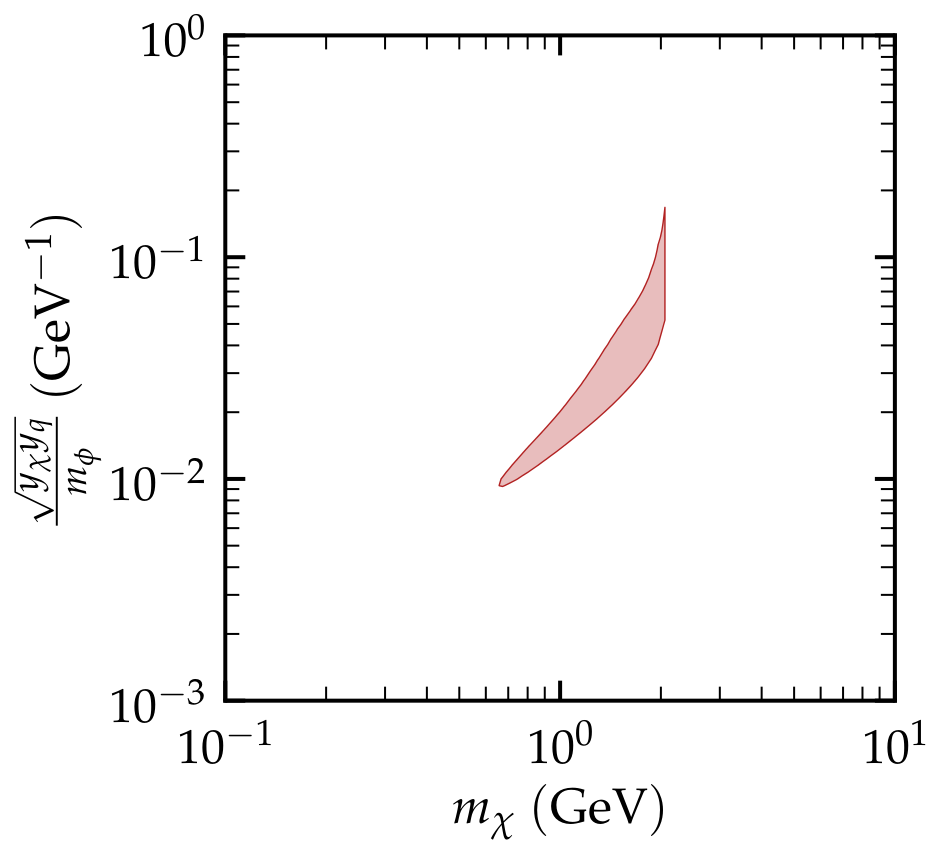
Jeesun and Majumdar didn't just propose the idea; they explored the conditions under which it could happen. Their work outlined the characteristics such a new particle would need to possess, and how it might interact with the known universe through a "go-between particle, a "scalar mediator." For instance, they showed that if this new, unexpected particle had a mass of roughly one billion electron volts – a standard unit in particle physics, a bit heavier than a proton – and interacted with a specific strength, it could perfectly account for the observed event.
This new explanation is more than just a clever theoretical twist; it opens up entirely new avenues for exploring the universe's hidden machinery. It reminds us that our most sensitive detectors, while often built for a specific quest like dark matter, are also listening posts for the utterly unexpected. The future generations of neutrino experiments, already on the drawing board, are being designed with precisely this kind of broad sensitivity in mind. They are preparing to detect not just the phenomena we anticipate, but also the ones we haven't even begun to imagine. The quiet vigil deep beneath South Dakota continues, but now, the scientists listening might be tuned to an even wider spectrum of whispers, searching for the next profound surprise carried by the universe’s most abundant, yet elusive, messengers. ◆
Sourced from: "Atmospheric neutrino up-scattering explanation of LZ 2026 excess" by Sk Jeesun and Anirban Majumdar