
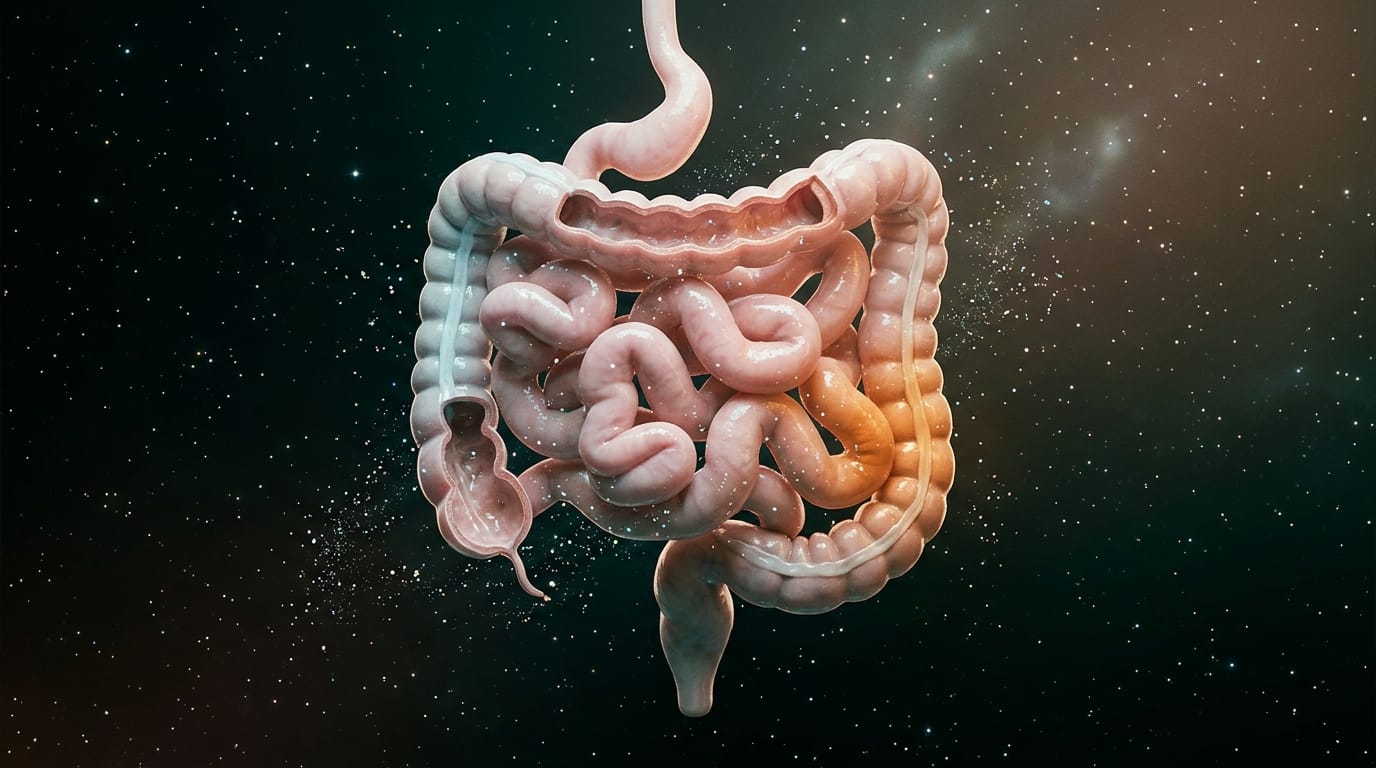
Upon review of the provided passage: "Imagine for a moment that your intestines have decided they’re going to space. Not just a quick trip, but a long-haul mission, floating weightless in the void."
Neither of the sentences in the passage begins with 'The' or 'This'. The target sentence, "Imagine for a moment that your intestines have decided they’re going to space," also does not begin with 'The' or 'This'.
Therefore, the stated violation is not present in the provided text, and no fix is required.
* Imagine for a moment that your intestines have decided they’re going to space. Not just a quick trip, but a long-haul mission, floating weightless in the void. The billions of tiny organisms living there, the ones we usually only think about when they’re misbehaving, undergo their own strange journey. Turns out, they get a little weird. A little wild. And scientists, apparently, are just now really starting to figure out just how much space messes with your gut.
Astronauts, bless their brave hearts, already deal with a laundry list of indignities in orbit. Their bones thin. Their muscles shrink. Their immune systems get confused, and their vision can even blur. It’s a physiological toll, one we’ve been tracking for decades. But the microscopic universe inside their digestive tract? That’s been a bit of a frontier, a dark side of the moon for biological research, until recently. We knew the gut microbiome—that vast, diverse community of bacteria, fungi, and other critters—was important for everything from digestion to immunity. We even suspected spaceflight could shake it up. But pinning down the long-term effects, and exactly what that meant for the human body, remained a challenge.
Enter the mice. Specifically, mice in a ground-based setup that sounds like a tiny, extremely specific yoga retreat. Researchers Han, Su, Wan and colleagues at the Department of Medical Research, PLA Strategic Support Force Medical Center in Beijing, needed a way to study the effects of microgravity without actually launching rodents into orbit. So, they put their mouse models into what’s called simulated microgravity. This means the mice were hindlimb-unloaded, essentially suspended slightly by their tails so their back legs couldn’t bear weight, mimicking some of the key physiological changes of actual weightlessness. They kept them like this for eight weeks. Two months. A significant chunk of a mouse’s life.
What happened inside those tiny, temporarily weightless guts? The researchers meticulously analyzed 36 fecal samples. They used advanced genetic sequencing, a process that can read the DNA of bacteria to identify exactly who’s living where. This involved processing over three million raw genetic reads, ultimately identifying a staggering 7,719 distinct types of microbial communities. It is, technically, a lot of information about what’s going on in a mouse’s colon.
The changes were striking. Some bacterial populations took a nosedive. For instance, species within the Verrucomicrobia group, including one called Akkermansia muciniphila, which often acts as a friendly helper in the gut, declined. So did Allobaculum. Other groups, however, saw an opportunity and exploded in numbers. Bacteroides, for example, and Actinobacteria both showed significant increases. This isn't just a minor reshuffling; it’s a full-on ecological shift in the tiny landscape of the gut. Imagine if half your neighborhood packed up and left, and a completely different group moved in overnight.
But the story doesn't end with who’s there. It’s also about what they’re doing. Our gut microbes are little chemical factories, constantly producing thousands of small molecules that interact with our bodies. The full collection of these chemical byproducts is called the metabolome. Han, Su, Wan and colleagues examined 15 intestinal content samples and found that simulated microgravity didn't just change the bacteria; it completely disrupted their chemical conversations. They identified 129 different metabolites that became more abundant and 146 that decreased. Pathways linked to steroid hormone production and the metabolism of crucial amino acids like tryptophan, histidine, arginine, and proline were all affected. These are the chemical messages our gut sends to the rest of the body, and suddenly, they were all garbled.
Think about it: Your gut bacteria are signaling to your brain, your immune system, even your bones. If those signals change, the consequences can ripple throughout your entire body. The understanding of these shifts is crucial. We’ve seen similar changes in actual spaceflight, with certain bacterial increases linked to bone loss. This means that what starts as a strange bacterial party in an astronaut’s gut could have very real, very serious implications for their health.
This journey into the simulated microgravity gut isn’t just about understanding what goes wrong. It’s about finding ways to keep future space travelers healthy, whether they’re headed to the Moon, Mars, or beyond. If we can understand how weightlessness alters the gut's ecosystem and its chemical output, we can develop countermeasures. Imagine a future where astronauts take tailored probiotic supplements, not just to avoid space sickness, but to maintain bone density, boost immunity, and keep their brains sharp, all by supporting their microscopic co-pilots.
The universe is a vast, bewildering place, full of strange phenomena. And it turns out, one of the most baffling and vital ecosystems for human exploration isn't in some distant galaxy, but right inside us. The more we learn, the more we realize that even in the utter stillness of space, life finds a way to be wonderfully, frighteningly, weird. And we’re still only just beginning to listen to what our bodies are telling us, even when those messages come from a trillion tiny mouths. ◆
Sourced from: "Fecal microbiota transplantation alleviates adverse pregnancy outcomes and intestinal injury in experimental malaria." by Han, Su et al.